

120 cm shelf: load capacity, materials and Danish craftsmanship
A 120 cm shelf must be able to support books, plants and equipment without noticeable deflection. Stiffness is crucial here, not just thickness. Stainless steel provides the necessary modulus of elasticity and yield strength, so the shelf maintains its shape under load and over time.
Material and load capacity at 120 cm
Austenitic quality stainless steel, typically 304 or 316, has a modulus of elasticity of approximately 193 GPa, which according to MatWeb's datasheet for 304 results in significantly lower deflection than porous or fibre-based sheet materials over the same span. This is supported by technical overviews from Lancaster University, which show steel's high stiffness level as constant across slender profiles. In addition to stiffness, the alloy provides good corrosion resistance; 316 offers particularly good resistance to chloride-containing environments, while 304 is fully sufficient in most indoor contexts.
For a 120 cm shelf, this means you can work with a relatively slim profile and still move critical deflection away from the visible zone. The practical consequence is a high load capacity per linear centimetre and a sense of calm in the line, even when the shelf is loaded with books along its entire length.
Steel, MDF and solid wood on the same span
When selecting a material for a 120 cm span, stiffness and load capacity determine the profile thickness, need for supports, and surface durability.
- Steel: MOE ~193 GPa, high yield strength, stable geometry for thin profiles. Good corrosion resistance and dimensional stability.
- Solid wood (e.g. oak): MOE typically around 10–13 GPa, according to Holzforschung published by De Gruyter and data from The Wood Database. Wood provides tactile warmth and natural damping, but requires greater thickness or closer console placement to keep deflection low at 120 cm.
- MDF: Significantly lower MOE in bending than solid wood, documented in several material studies. A 120 cm MDF shelf requires increased thickness or central support for comparable load capacity.
The conclusion is practical: If you want a 120 cm shelf that looks slim but actually supports books, ceramics, and small equipment without bending, stainless steel is the most predictable choice. Wood can be chosen for its texture, but should be dimensioned accordingly, while MDF is rarely appropriate for long spans without additional support.
Skagen: wall-mounted 120 cm steel shelf
Acier Studio's Skagen shelf is handcrafted in stainless steel in Aarhus, with a slim, brushed surface that recedes, allowing the objects to take centre stage. In the kitchen, it holds coffee equipment and ceramics without appearing heavy; in the living room, it supports a potted plant, books, and small sculptures in a single line. The visual calm comes from a consistent profile and a finish that distributes light without glare.
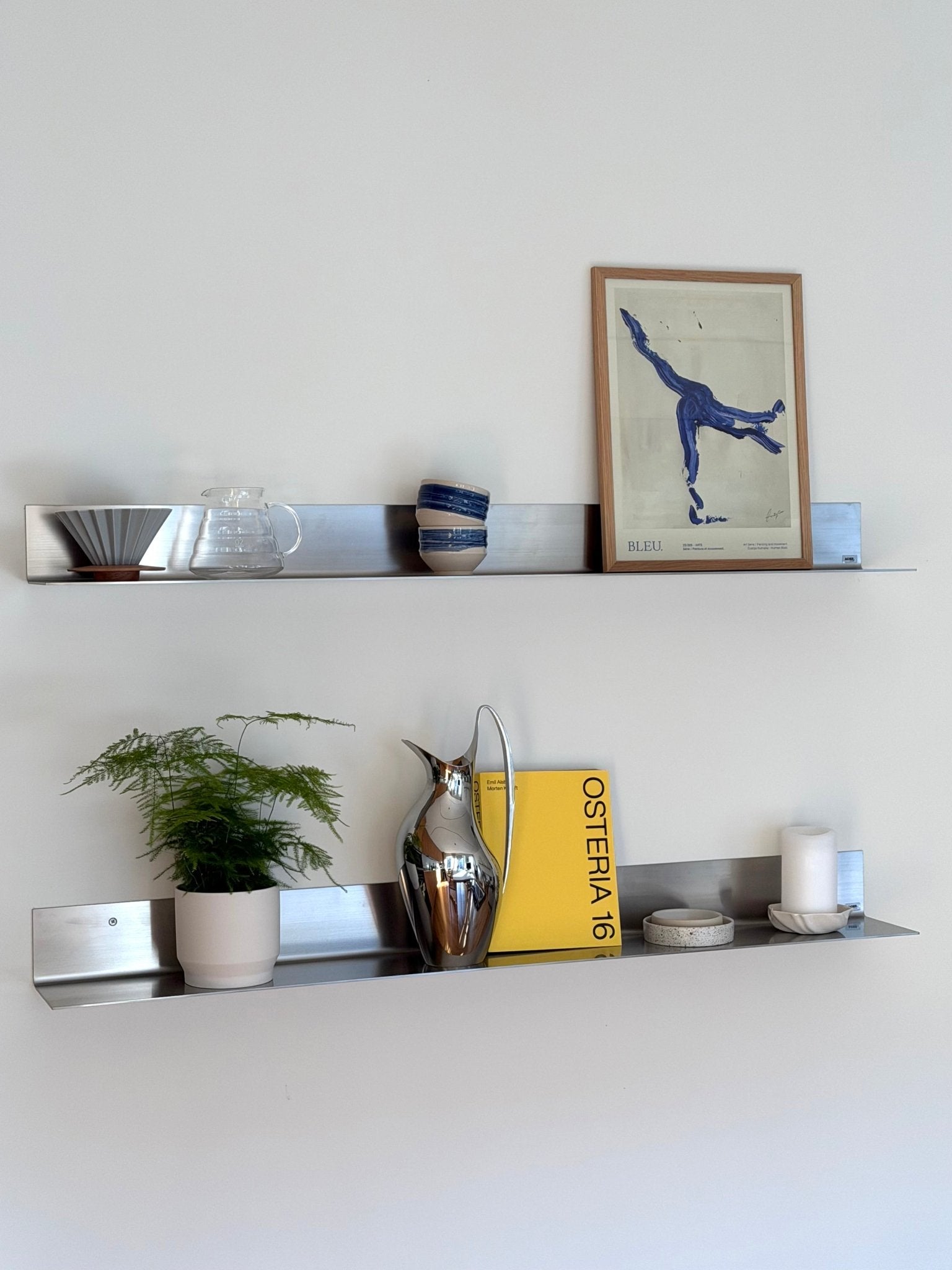
In production, we work with tight tolerances, clean edges, and a uniform satin brush finish, so the shelf reads as one coherent surface. This approach is rooted in Danish design tradition, where function, proportion, and material honesty are guiding principles, as described by the Danish Design Council. Skagen is available in 120 cm and matches both compact and more generous wall spaces. Read more about the product on the Skagen page at Acier Studio.
Installation, load and styling in practice
To get the most out of a 120 cm steel shelf, installation and load distribution are as important as the material.
- Substrate: In solid walls (brick/concrete), use quality plugs of the correct diameter and length. In plasterboard, metal cavity anchors or mounting into studs are recommended, depending on the load. Always follow manufacturer's instructions for the shear load of the anchor, and choose screws that provide full grip.
- Bracket spacing: Two solid attachment points at each end are the minimum; three points further reduce deflection at 120 cm, especially with heavy book loads.
- Load distribution: Place the heaviest books or appliances closer to the wall supports. An even, continuous load results in lower maximum deflection than point loads. As a rule of thumb, visual deflection should be kept below approximately L/200; for 120 cm, this corresponds to about 6 mm.
- Thermal and moisture: Stainless steel is dimensionally stable under normal indoor conditions, so doors or surrounding elements are minimally affected by the shelf's movement.
In interior design, material contrasts play a role. Combine the brushed steel surface with warm wood tones and textiles to balance the technical expression. Choose a matte or brushed finish to avoid glare in work areas, and consider whether visible joints should be highlighted or toned down, depending on the room's character. This approach aligns with how modern Danish design works with context and material, as presented on denmark.dk.
Maintenance and long-term value
Stainless steel requires little, but precise maintenance to preserve its finish and the shelf's geometry over the years.
- Cleaning: Wipe regularly with a microfibre cloth lightly dampened with a pH-neutral soap solution. Wipe in the direction of the grain. Avoid chlorine and bleach-containing agents, which can cause pitting, especially on 304.
- Stains and grease: Use isopropyl alcohol on a soft cloth for spot degreasing. Always test on an inconspicuous area first.
- Scratches: Small surface scratches can be toned down with a fine sanding pad (typically 1000–1500 grit) applied in a consistent direction with very light pressure. Stop before the surface becomes shiny. Deep or cross-grain scratching should be handled professionally.
- Contact corrosion: Avoid contact with ordinary steel wool or iron particles, which can cause flash rust. Only use stainless or non-abrasive tools.
- Water and plants: Use saucers under pots and wipe up condensation to prevent limescale and watermarks from setting in.
- Fasteners: Lightly retighten screws after the first few weeks and then annually, especially on plasterboard walls. Check that anchors show no signs of movement.
Over the long term, the value of a 120 cm stainless steel shelf is threefold: the material's stiffness ensures dimensional stability under load, its corrosion resistance keeps the finish intact without a lacquer buildup, and Danish craftsmanship in Aarhus maintains proportions and tolerances that do not go out of style. Compared to thicker MDF or wooden solutions, which often have to be oversized or supported, a slender steel profile provides a calm expression with fewer compromises. This creates a discreet, robust infrastructure in the room that can accommodate changing content and new functions for many years. References: MatWeb for 304 data, eprints.lancs.ac.uk for an overview of steel stiffness, De Gruyter/Holzforschung and The Wood Database for wood properties, and Danish Design Council for Danish design DNA.

