

60 cm Shelf: When is the Length Right, and What Can a Compact Steel Shelf Hold?
A 60 cm shelf solves a specific need: enough space for daily items without dominating the wall. This length is often the most precise for hallways, niches, and above narrow elements like radiators or concealed cistern toilets. It can stand alone as a focal display or be repeated in sections where the wall defines the frame. The question is therefore twofold: Is 60 cm the right proportion for the space, and what profile and mounting provide the load-bearing capacity for what you want to place on the shelf?
When is 60 cm the right size?
This length works when furnishings and wall surfaces require precision. It leaves visual breathing room in smaller spaces and aligns cleanly with narrow wall sections. In modular setups, 60 cm can be repeated with equal spacing, maintaining a calm and functional rhythm. This length typically accommodates a compact composition without creating clutter: a stack of smaller books, a ceramic object, a candle, and a bowl for keys. In the kitchen or dining room, 60 cm is often just enough for two to three pieces of tableware in daily rotation.
The material reinforces the sense of precision. Used visibly in brushed stainless steel, the shelf stands out clearly against the wall, or it can contrast warm materials like oak or teak. Paired with raw concrete, it creates the cool-against-warm tension often seen in Danish modernism; this dialogue is also evident in contemporary series like Lilium by Fritz Hansen, where steel and wood are balanced in a light, functional whole (Fritz Hansen).
What can a compact steel shelf truly bear?
Load-bearing capacity depends on geometry, material quality, and mounting. AISI 304 and 316 are austenitic stainless steels with an elastic modulus of approximately 193–200 GPa and typical 0.2% yield strengths in the range of 200–250 MPa. This provides sufficient stiffness for shelf use, but perceived deflection is practically controlled by thickness, profile, and fastening. 316 resists chlorides better than 304 and is therefore often chosen for coastal or humid environments, as documented by MatWeb (MatWeb: https://matweb.com/search/DataSheet.aspx?MatGUID=abc4415b0f8b490387e3c922237098da).
For a 60 cm span, the starting point is favorable because the length is short. Serviceable deflection is typically dimensioned according to a limit such as L/180 to L/360; for 600 mm, this corresponds to approximately 3.3 mm of deflection at the lenient end and 1.7 mm at the stricter end. Classic beam formulas—for example, δ = 5wL^4/(384EI) for a simply supported shelf—provide a realistic picture of what a given profile can withstand. For quick estimates, tools like WoodCalcs are useful in the design phase (WoodCalcs: https://woodcalcs.uk/furniture-design/shelf-span-calculator/).
What does this mean for a "compact steel shelf"? A flat steel plate of 1–2 mm in a pure flat profile will be suitable for light decoration, smaller tableware, or small paperbacks. If you want to carry heavier items or higher distributed loads, stiffness is significantly increased by:
- an angled or bent profile that moves material to the edge and increases the moment of inertia
- thicker plate, typically 3–6 mm, in combination with solid brackets or concealed supports
Anchoring to the wall is crucial. Mounting in load-bearing wall studs, solid masonry, or with chemical anchors in porous materials significantly improves capacity. Concealed embedded supports or long brackets with deep engagement also reduce perceived deflection because the support is closer to the loaded center.
Skagen in practice: 60 cm as a precise, bent steel shelf
Acier Studio's wall-mounted Skagen shelf is a technical interpretation of the compact length. The studio photo shows three shelves of different lengths arranged vertically against a white background, without props. Viewed from above, the bent profile, the fine, linear brushed texture of the steel surface, and the sharply drawn edges are highlighted. The folded geometry acts as an integrated stiffener, allowing the shelf to maintain its flat calm under daily load, while the clean cut creates a graphic shadow against the wall. The 60 cm version strikes a balanced scale between a single focused setup and a module that can be repeated without disrupting the wall's proportions.
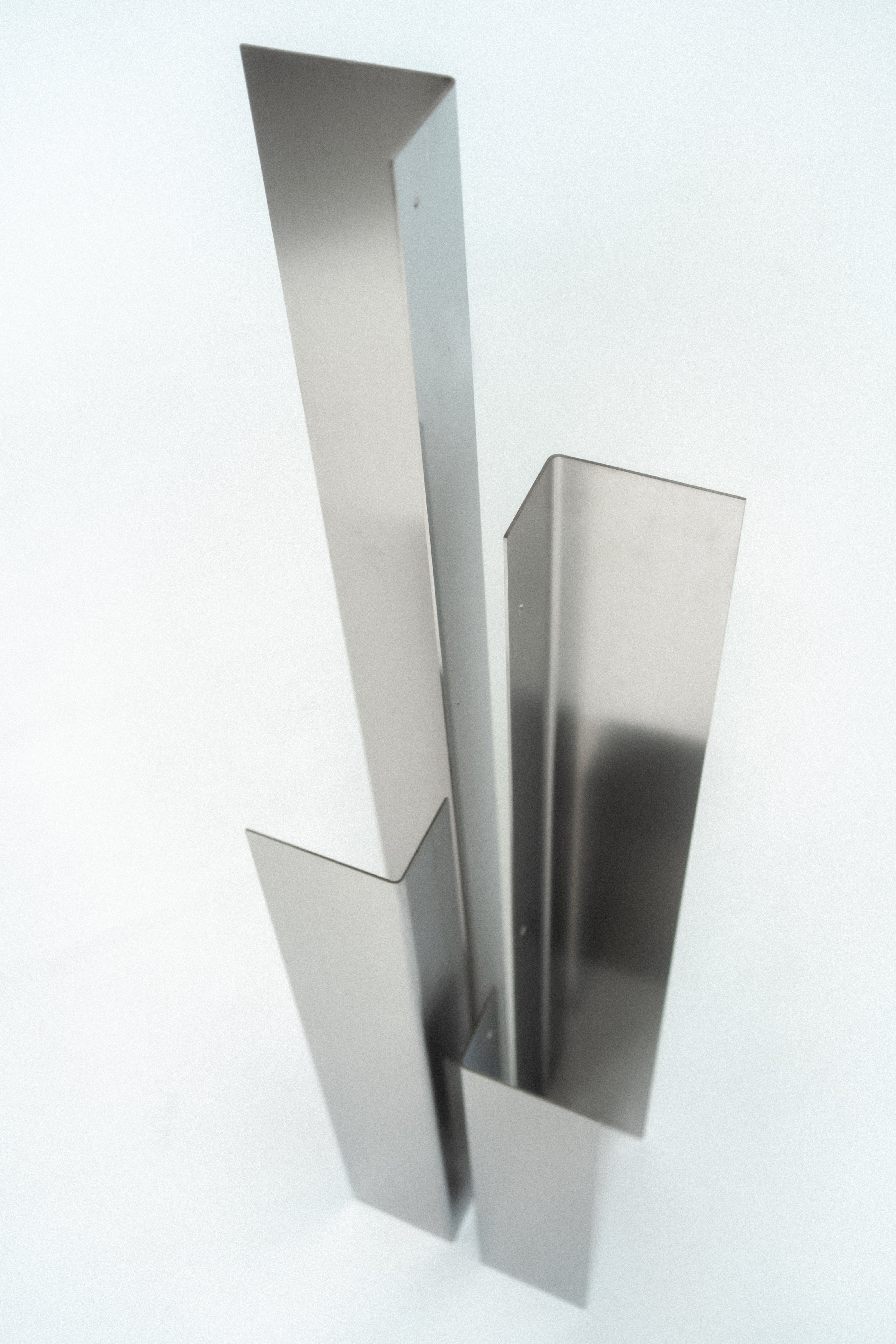
If you want to delve into proportions and finish, you can take a closer look at the Skagen steel shelf at Acier Studio, where dimensions and surface are specified to assist with correct mounting and loading (https://acier.dk/products/staalhylde-skagen).
Materials, construction, and Danish manufacturing
The choice between AISI 304 and 316 should follow the environment. In dry, indoor environments, 304 is often the rational solution. In bathrooms, kitchens near sea air, or commercial environments with cleaning agents that may contain chlorides, 316 is the safer option in the long term, which MatWeb's datasheet supports with documented corrosion properties.
The structural geometry is as important as the alloy. A subtle edge or a bent return flange often doubles the perceived stiffness for most everyday loads on 60 cm. For particularly heavy tasks or public environments, a box profile or concealed rib behind the front edge can be used. Here, a simple calculation in the design phase provides clear direction before production or assembly; distributed load, chosen profile, and wall type should be assessed holistically.
Acier Studio's production in Aarhus is characterized by precision bending, uniform brushing across surfaces, and clean joints that are hand-deburred. Local workshop craftsmanship means that material documentation and finishing can be tightly controlled, ensuring that transitions and edges appear straight and defined over time. This is not about embellishment, but about controlling tolerances and finish that endure in use.
Mounting and maintenance: specific advice
- Always fasten into suitable substrate. In masonry: use appropriate plugs and depth, and avoid placing plugs close to joints. In lightweight concrete and aerated concrete: choose chemical anchors or specialized plugs that distribute the load. In light plasterboard walls: find studs or use system fittings that distribute at multiple points.
- Retighten after the first week of use, once materials have settled, and check annually to detect micro-movements.
- Clean brushed stainless steel with a pH-neutral agent and microfiber cloth in the direction of the grain. Wipe dry with a dry cloth to avoid limescale streaks.
- Avoid chlorine-containing cleaning agents and bleaches. In coastal environments, occasional rinsing with clean water and wiping can reduce deposits. Wax or oil products that promise "steel effect" can leave a film; test in a corner first.
- If the shelf is exposed to salt or acid splashes, clean immediately. Choose AISI 316 in exposed areas to minimize the risk of tea staining corrosion, as documented in material literature by MatWeb.
For dimensioning and deflection control, you can use a simple estimation tool like WoodCalcs mentioned above. This validates that the profile and wall anchorage match your use.
Perspective on long-term value
A 60 cm steel shelf is a modest module, but its value lies in precision: the correct alloy for the environment, a profile that bears its own length without visual disturbance, and mounting that respects the wall. When combined with careful bending and brushing, you achieve a shelf that withstands close inspection and daily use for many years. It ages not by hiding, but by maintaining the sharpness of its edge and the calm of its surface—a quality that makes the investment rational over time. In interior design, this means less replacement, stable visual order, and a surface that can be serviced, not replaced. This is the core of lasting Scandinavian utility value.

