

Shelf with brass brackets: when the fittings work for the room
A shelf with brass brackets primarily solves a practical problem: it safely and visibly supports loads. Visible brackets reveal force distribution and mounting points, simplify the spacing between brackets, and clarify how much the shelf can realistically bear. In the kitchen or wet-room adjacent areas, it is advantageous that load-bearing metal parts are robust, easy to clean, and visually assessable. When the brackets are made of brass and set against a steel shelf, the function simultaneously becomes a conscious design element, not something to be hidden away.
Function, proportion, and load capacity
The depth of the bracket, the shelf's material, and the wall type must be considered together. A deep shelf with heavy loads requires deeper and stiffer brackets, a solid substructure, and precise center spacing between the fittings. In plastered walls or above tiles around a sink, visible brackets provide a precise layout; holes can be read and adjusted with minimal risk of hidden errors.
Proportions matter visually. Slender, flat steel shelf surfaces read cool and light; brass brackets add warmth and rhythm. Choose the width of the support and the visible thickness of the shelf edge so that the lines balance load and negative space. In series produced in small batches—as in our Aarhus workshop—tolerances, screw heads, and joints are harmonized so that the bracket appears as an architectural detail rather than a compromise. This approach, where craftsmanship and material honesty are prioritized over quick solutions, is a line also highlighted in Danish professional circles and exhibitions; DMK describes how this tradition delivers longer-lasting results through controlled details and finishing work (see dmk.dk/the-masters-tradition-craftsmanship).
Materials and surfaces: steel grade, brass, and finishing
The performance and color play of the steel shelf are determined by alloy and finish. Austenitic grades such as 1.4301/304 and 1.4401/316 are the most commonly used indoors. 316 contains molybdenum, which increases resistance to chlorides and pitting corrosion; this is relevant in coastal environments or above sinks where splashes and cleaning agents are a factor. According to the British Stainless Steel Association, SSAS 1.1: Introduction to Stainless Steel, it is the chromium-rich, passive film on the surface that ensures corrosion resistance, and the homogeneity of this film depends on grinding, welding, and subsequent passivation (bssa.org.uk/wp-content/uploads/2022/05/SSAS1.1-Introduction-to-Stainless-Steel.pdf).
The surface should be determined early and kept consistent throughout production. A No.4 brushed finish provides an even, satin-ground appearance that matches fixtures and appliances, while bead-blasting dulls reflections and mirror polishing introduces more light and sharpness. Welds should be performed as TIG welds, subsequently ground and chemically passivated or electropolished, so that the color tone is not broken by heat tinting. Brass brackets can be chosen lacquered to maintain color or unlacquered to develop a patina; both solutions are legitimate, but they are managed differently in use.
A brief specification checklist:
- Steel grade: 304 for dry interiors, 316 in coastal or humid zones
- Finish: No.4 brushed for calm uniformity; bead-blast for a more matte reading
- Finishing: TIG weld, grind, passivation or electropolishing for color uniformity
- Brass: choose lacquered for stable color, unlacquered for controlled patina
- Separation: use washers/spacers between brass and steel in outdoor or humid conditions to minimize galvanic effects
Skagen in the kitchen: reading the steel surface in daily use
Acier Studio's Skagen is a wall-mounted stainless steel shelf with a brushed finish, shown here mounted above a kitchen sink. The surface naturally complements the other metal elements in the room—faucet, kettle, and glasses—while ceramics and wood add tactile contrasts. The flat, precisely bent steel plate forms a calm, even base for everyday objects, and the shelf visually works with the chrome spout and the light wall without appearing ornamental. In a setup with brass brackets, the warm fittings will act as anchoring points, creating depth in the composition and binding steel and organic materials together.
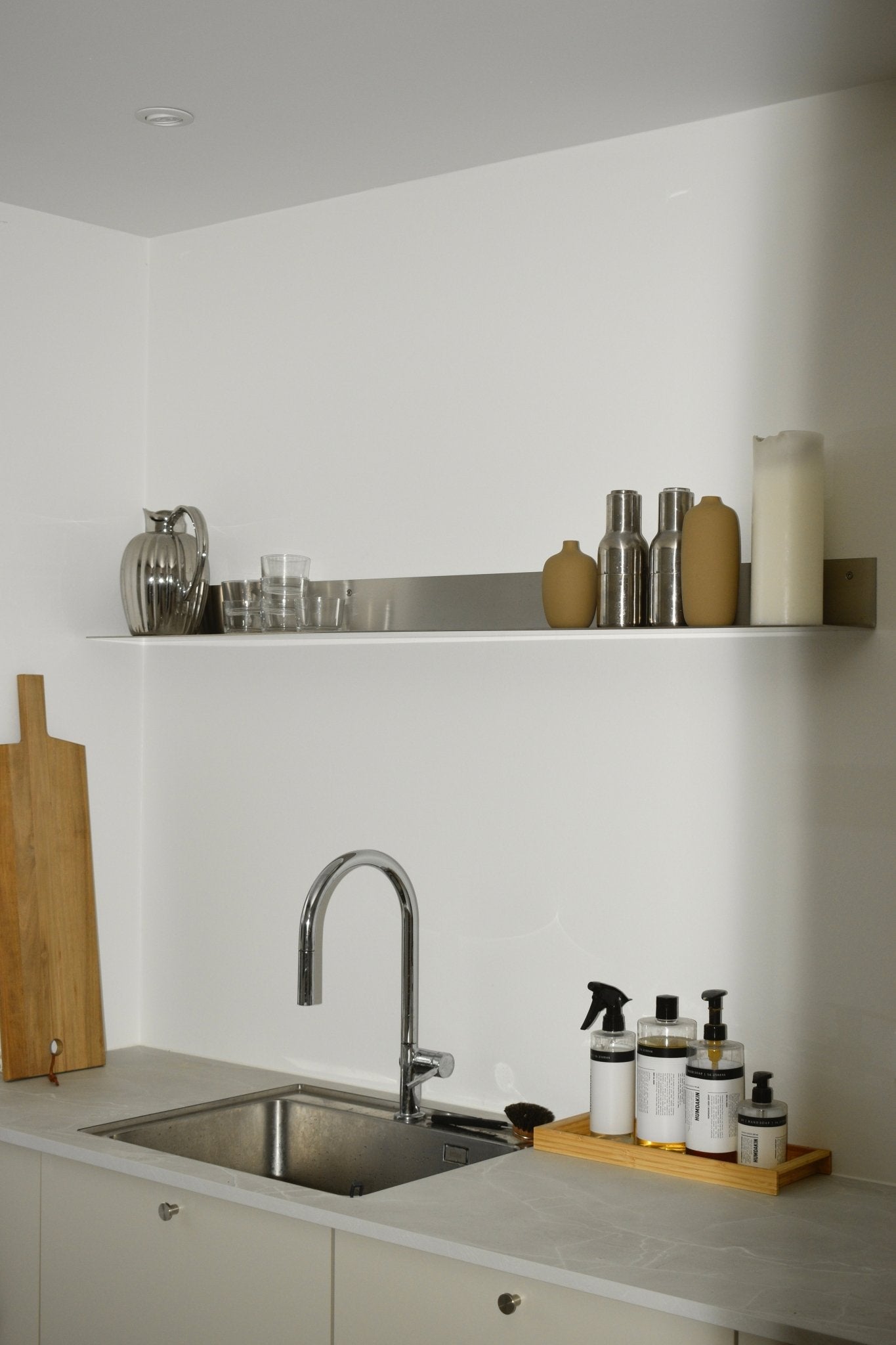
Skagen demonstrates how a steel shelf can live in an active kitchen environment without drawing focus. If you wish to see more details, you can find the product under Skagen steel shelf on acier.dk.
Maintenance and installation: specific actions that pay off
Stainless steel:
- Clean regularly with lukewarm water and pH-neutral dish soap. Wipe in the direction of the grain with a microfiber cloth to avoid streaks.
- Avoid chlorine-containing agents and scouring powder; residues of chlorides can attack the passive film over time, especially around sinks and in coastal zones.
- Remove metal particles from steel wool or tools with a soft cloth; free iron can cause flash rust.
- For stains: use a non-abrasive steel cleaner and rinse thoroughly. The passive film rebuilds naturally in air, but keep the surface clean and dry.
Brass brackets:
- Lacquered brass: wipe with a damp, soft cloth. No polishes or solvents that can attack the lacquer.
- Unlacquered brass: accept natural darkening, or use a mild, non-abrasive brass polish in small amounts. Polish locally so the fittings age evenly.
- Avoid prolonged contact with acids, salt, and vinegar from cooking; wipe up spills immediately.
Installation:
- Pre-drill carefully and use appropriate wall plugs for the wall type. For tiles, drill in grout lines when possible, or use a tile drill and low pressure.
- Tighten fittings evenly; overtightening can distort both brass and steel. Re-tighten after 1–2 weeks, once materials have settled.
- Insert non-conductive washers between brass and steel in humid environments to reduce galvanic effects. Keep screws and fasteners dry.
Interaction with wood, steel, and concrete
Think of the shelf as a narrow, horizontal surface and the brackets as jewelry that define the rhythm. Brass brackets against brushed stainless steel provide a controlled warmth that suits both oak and walnut; the wood grain brings tactility and makes the interaction more homely. Concrete and polished natural stone add mass and material contrast, highlighting the precision of the metal. In more industrial or strictly Scandinavian spaces, black-burnished steel in nearby furniture acts as a shadow that allows the brass fittings to stand out without being loud.
The scaling of the brackets is crucial. Narrow, long shelves read most easily with slender yet rigid supports in a steady rhythm, while deeper shelves can bear larger, calmer brackets that visually anchor the wall surface. Let the center distance, shelf depth, and line thickness work together so that the wall achieves an architectural reading instead of random storage.
When a shelf with brass brackets is handcrafted in Aarhus, with TIG welds, ground transitions, and small series variations that preserve the grain direction and patina, the details speak for themselves. This difference is felt daily in the angles, in the meeting between metal and wood, and in the absence of visual disturbances that often accompany mass production.
In the long run, the combination of stainless steel and brass delivers durability that can justify the investment. The steel surface retains its shape, brass ages with character, and the two materials can be maintained, re-lacquered, or polished as needed. When proportions, material selection, and finishing are correctly chosen from the start, one achieves not only a strong shelf; one gets a calm, scalable element that continues to work for the room year after year.

