

Shower shelf: why most fail, and how stainless steel provides a lasting solution
Most shower shelves corrode because they are made from materials and with surfaces that cannot withstand chloride-containing, stagnant water in joints and behind fixings. Typical alloys like 304 (18/8) can resist ordinary moisture but develop pitting and crevice corrosion when soap residue and hot shower water with chlorides accumulate in corners, screws, and behind silicone joints. These weaknesses are accelerated where oxygen supply is low, as this is where the passive film on the steel breaks down first. The result is discoloration, "tea-staining," and small pits that quickly become permanent.
Material selection and surface treatment that work
For shower enclosures, shelves and fittings should be made from 316 steel with molybdenum; this addition provides a more stable passive film in chloride environments than 304. The International Molybdenum Association (IMOA) specifically describes 316 as the standard choice for wet rooms where particular chloride loads occur, emphasizing good drainage and cleaning as prerequisites for lasting resistance (see IMOA’s technical review).
The surface is as crucial as the alloy. A brushed or ground finish is tactile and discreet, but the micro-grooves left by grinding can retain films of water and salts. A mirror-polished surface is denser, but practical maintenance requires experience. Electropolishing electrochemically smooths the topography and reduces micro-anchors for deposits; subsequent chemical passivation (citrate- or nitrate-based) rebuilds a chromium- and molybdenum-enriched passive film. When passivation occurs according to recognized processes like ASTM A967, and the component is thoroughly rinsed, the risk of pitting is significantly reduced.
Our own production in Aarhus works with small batches and controlled grinding patterns; welds are fully ground and rounded so that water does not collect in sharp corners. You can read about our approach to materials and finishing in our review of production and materials.
Installation without weak points
Corrosion often starts in fasteners, behind washers, and in enclosed cavities behind adhesive or silicone joints. It's not enough to choose a good alloy; the construction and installation must avoid oxygen-deprived crevices and allow for free drainage.
- Use through-bolted or openly ventilated brackets instead of full-surface adhesive mounting; avoid "pockets" behind the shelf.
- Specify A4/316 screws, anchors, and spacers so that all metal contacts are in the same corrosion resistance class.
- Adjust drill holes so screws do not wedge the steel and create micro-cracks; use appropriate washers and avoid soft gaskets that trap water.
- Install the shelf with a minimal slope towards the front edge; this reduces water film and soap residue.
- Finish with chemical passivation of machined edges after cutting and drilling, and rinse thoroughly before use.
In solid stone or tiles, through-bolts with a back plate are stable and open for ventilation. For light walls, expansion anchors in corrosion class A4 or equivalent are chosen. Silicone can be used as a secondary seal against water in drill holes but should not serve as a load-bearing layer behind the entire underside of the shelf, as this creates an oxygen-deprived crevice.
Skagen stainless steel wall shelf
Skagen is our simple stainless steel wall shelf. In a kitchen environment, it demonstrates how a calm, brushed surface integrates with both steel and ceramics; the same discipline is applied to wet rooms, where material logic and drainage are more important than decor. The shelf withstands daily use without adding visual weight, and its flat, precisely ground top is easy to keep clean.
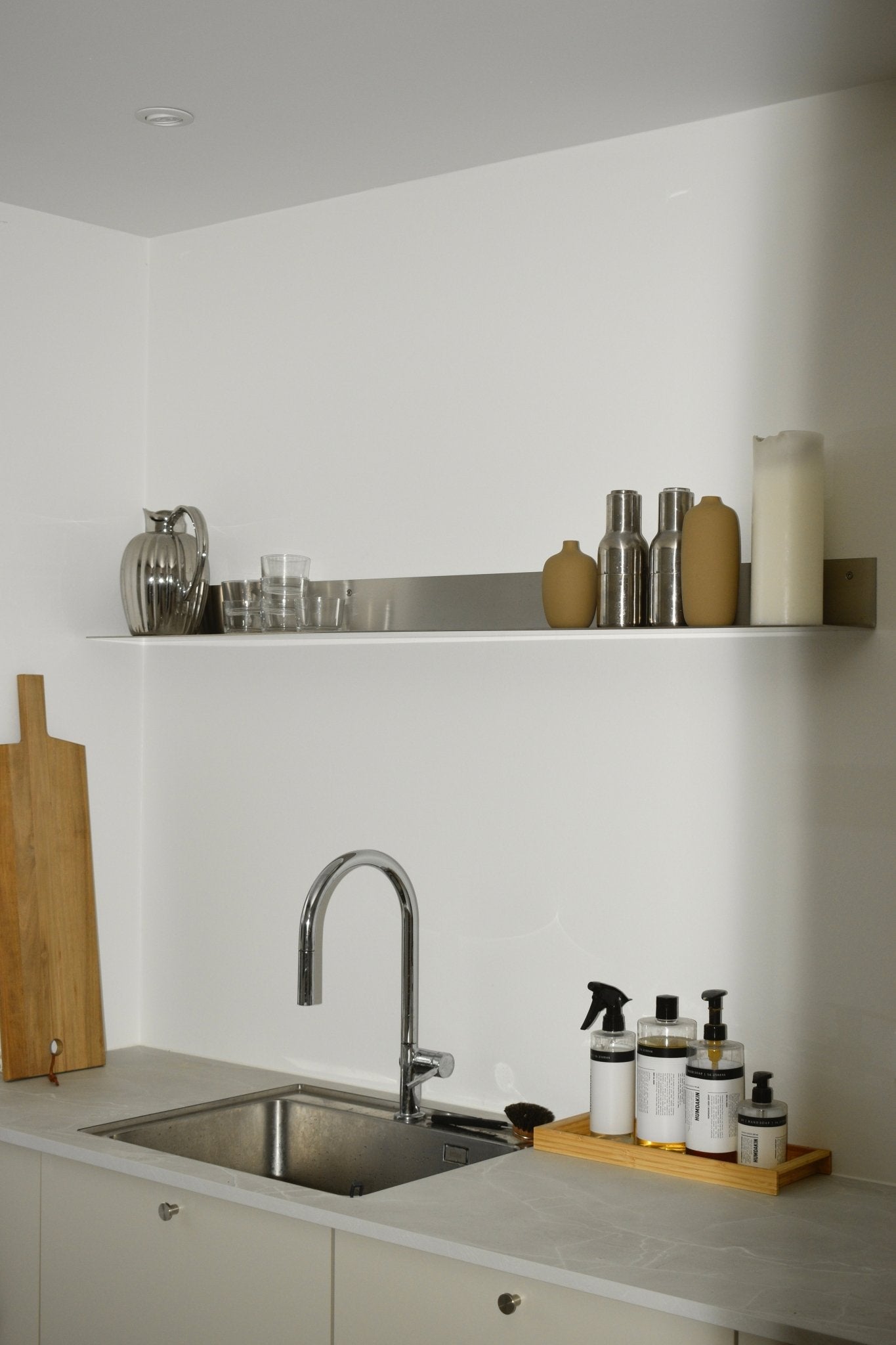
In the shower cabin, we recommend mounting at shoulder height to minimize direct spray from the showerhead, and a slight slope towards the front edge for quick drainage. We use TIG welding in small batches, and edges are deburred and rounded so that water film is broken and cleaning is simple. Where the room calls for a more built-in look, the shelf also works in a flat, linear layout with matte stone or light wood to soften the coolness of the steel. See product details for Skagen here.
Maintenance, honestly described
Even 316 steel can discolor if salts and soap residues are allowed to remain. This is not a material defect but a consequence of deposits that locally deplete the passive film. A regular, simple routine is sufficient.
Clean the shelf with cold to lukewarm water after use, especially if you use chloride-containing products or hard water. Wipe weekly with a pH-neutral, non-chlorine soap and a soft cloth. Rinse thoroughly and dry in the direction of the grain. Avoid chlorine, hydrochloric acid-based agents, and scouring powder; they attack the passive film and increase the risk of pitting. Light "tea-staining" can be removed with a fine non-woven disc (e.g., gray) in the direction of the grain, followed by rinsing and drying. If the shelf has been newly machined or ground, a mild citrate-based passivation can be applied and rinsed off according to the manufacturer's instructions to rebuild protection.
Pay particular attention to areas around fixings. Water and soap films accumulate here; rinse regularly and avoid sealing the entire contact surface with soft sealant.
Long-term perspective: Danish craftsmanship and value
Durability in wet rooms is achieved by combining three factors: correct alloy, well-thought-out geometry, and precise installation. Small-scale production in Aarhus gives us control over all three. TIG welds are thoroughly worked and ground, edges are rounded, and tolerances are kept tight to avoid water pockets. This is a different priority than mass-produced shelves made of thin steel with spot fastenings and decorative coatings; here, the purpose is to eliminate weak points rather than hide them.
A 316 shower shelf with proper finishing and documented passivation costs more upfront, but replacement, reinstallation, and repairs cost much more in the long run, both financially and aesthetically. When the shelf also naturally integrates with other steel elements in the home and the interior remains clean over time, it becomes a quiet but noticeable level of quality in everyday life. This is the essence of Scandinavian interior design: few, honest materials thoughtfully put to use.

