

Wall Shelves in All Materials — and Why Stainless Steel is the Most Durable and Timeless Choice
A wall shelf must bear weight securely, resist moisture and scratches, occupy minimal visual space, and be easy to keep clean. In modern homes, where kitchen, living, and work zones merge, the choice of material becomes crucial; it dictates both structure and daily maintenance. Here, stainless steel excels with corrosion resistance, high strength at low thickness, hygiene, and low maintenance — qualities rarely combined in any other single material.
Realities of Materials
- Wood/Veneer: Warm and repairable; reacts to moisture, can mark, and requires ongoing oiling/varnishing.
- Glass: Visually light and stain-resistant; fragile, shows dust and fingerprints clearly.
- Stone/Composite: Hard and heat-resistant; heavy, requires robust brackets and precise installation.
- Lacquered Steel: Stable and strong; lacquer can chip on impact, and edge repairs are visible.
- Stainless Steel: Stable, thin, and corrosion-resistant; the surface can be refined from matte to mirror and is easy to clean.
Stainless Steel in Practice: Alloy, Surface, and Performance
Stainless steel forms a thin, self-healing chromium oxide film that protects against corrosion. Outokumpu explains this passive layer formation and why alloy choice matters; typically, 304 is suitable indoors in dry zones, while 316 handles higher chloride loads in bathrooms or coastal environments (source: Outokumpu).
The surface dictates both appearance and use:
- Brushed: discreet reflection, better hides fingerprints.
- Satin: a slightly more glossy finish, still calm in the room.
- Mirror: maximum reflection, dramatic but requires more frequent wiping.
In shelf design, steel also means precise geometry. The strength-to-thickness ratio allows for a slender profile that appears light on the wall without sacrificing load-bearing capacity. For long spans, it is wise to choose thicker sheet metal or a folded construction with internal stiffening; this keeps lines sharp over time and minimizes deflection.
Skagen — the Wall Shelf that Recedes So the Room Can Speak
Skagen is Acier Studio's wall-mounted stainless steel shelf, developed in Aarhus and handcrafted with a focus on clean lines. The shelf is deliberately slender: its brushed surface dampens reflections, allowing the objects—not the shelf—to set the tone. The image shows a pair mounted horizontally on a white wall; on the upper shelf, coffee gear and ceramics are balanced, while the lower shelf holds a fern, books, and small sculptures. The setup demonstrates how the same profile meets both the practical needs of a kitchen and the more composed still life of a living room.
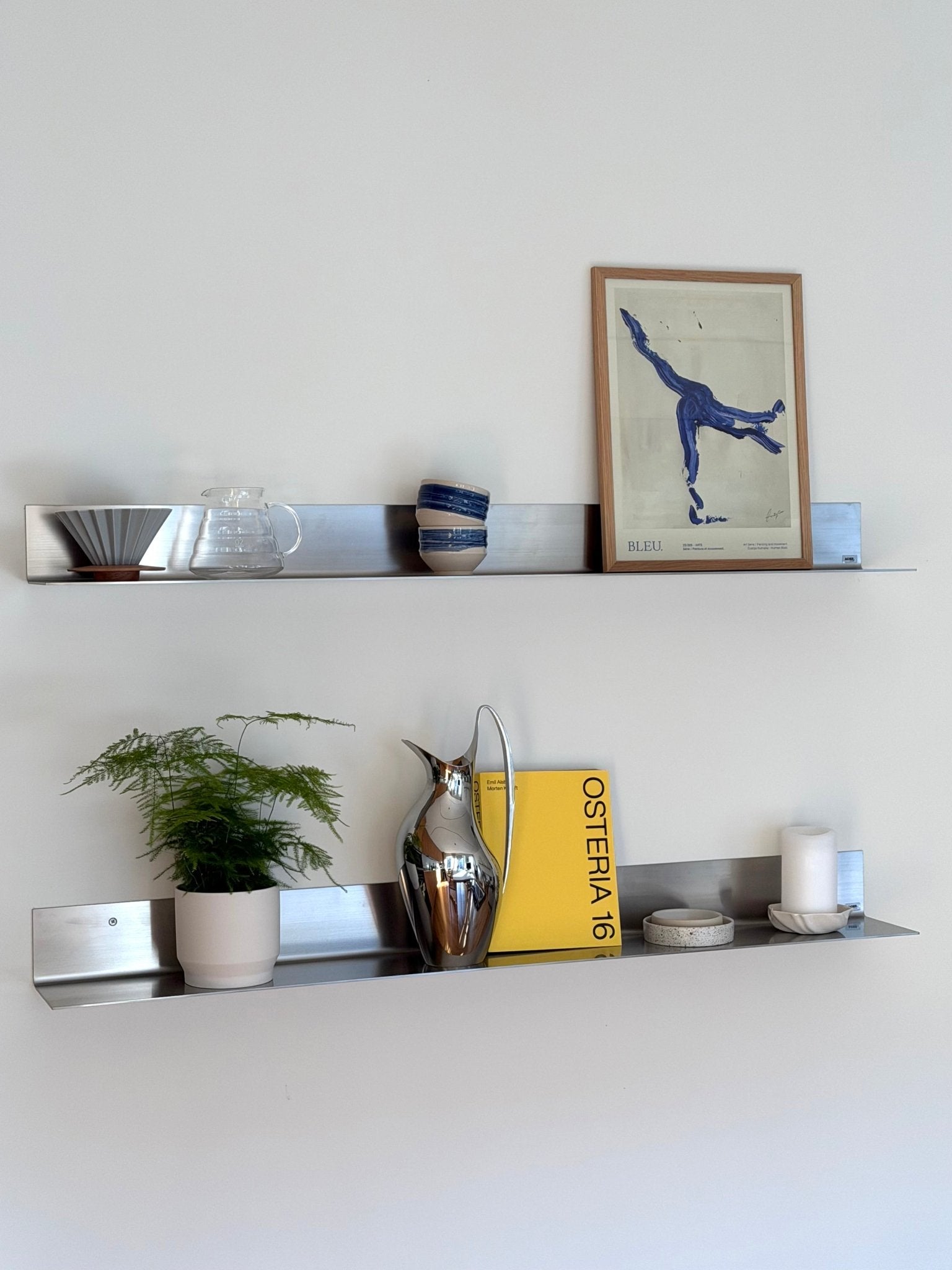
As a material contrast, Skagen works particularly well with warm oak, limewashed walls, or raw stone. Material mixing works best when proportions are balanced and textures do not compete; Fjord & Fuji reviews how calm metals can set the pace for wood and stone in modern interiors (source: Fjord & Fuji). Read more about the product's specifications on Skagen steel shelf.
Danish Manufacturing in Aarhus: Proportion, Joints, and Control
Acier Studio operates within an Aarhus metal tradition, where proportion, material honesty, and precise processing are central. In practice, this means tight tolerances in bending and flatness, clean edges without burrs, and consistent grinding direction, so shelves in the same room appear uniform. Small series allow time to optimize details such as bracket tolerances, fastening points, and surface gloss, so the shelves integrate into the wall without visible compromises.
Designmuseum Danmark describes how Danish furniture culture has historically combined function, honest materiality, and craftsmanship discipline — a practice that in metal involves secure joints, accurate jigging for repetitions, and a final finish that withstands everyday use without ritualized care (source: Designmuseum Danmark).
Maintenance and Installation: Practical Advice
- Cleaning: Wipe with microfiber and mild dish soap in water. Follow the grinding direction on brushed/satin surfaces to avoid transverse streaks. Wipe dry with a clean, dry cloth to prevent limescale marks.
- Avoid: Bleach/chlorides, abrasive scouring pads, and steel wool; these can damage the passive film or leave foreign iron, which discolors.
- Refurbishment: Fine Scotch-Brite pads can be used carefully in the grinding direction on brushed/satin; always test in an inconspicuous area first.
- Mounting: Use rawlplugs and screws suitable for the wall type (plasterboard with correct cavity anchors, solid brick/concrete with appropriate plugs). Distribute weight close to fastening points; place heavy, compact items within the bracket zone to minimize torsion.
- Environment: In bathrooms or coastal homes, 316 alloy provides an extra safety margin against pitting; in dry living areas, 304 is typically sufficient.
Long-term Durability and Circular Value
When considering the entire lifecycle of wall shelves, stainless steel is difficult to match. The surface ages slowly and predictably, and the load-bearing capacity remains stable without shrinkage or warping. The World Stainless Association estimates that 90–95% of stainless steel is recycled at the end of its use; this reduces both waste and the need for replacements over time (source: World Stainless Association). Combined with precise Danish manufacturing and a surface that can be serviced without special equipment, it results in a low total cost over the years — not only financially, but also in the peace of mind that comes from furnishing with elements that remain relevant as the home evolves.

