

Metal Shelf for All Rooms: Materials, Strengths, and When Stainless Steel is the Right Choice
A metal shelf is chosen for performance. It carries heavy loads with a thin profile, withstands daily wear and tear, and provides precise geometry for wall mounting. The choice between steel, iron, aluminum, and stainless steel determines the shelf's durability, maintenance, and visual harmony in the room.
Materials and When Stainless Steel is Right
Mild steel (carbon steel) is stiff and affordable but requires painting or powder coating to resist corrosion, especially in kitchens and bathrooms. Aluminum is light and easy to work with, but it is softer, dents more easily, and can appear less sharp at joints; over longer spans, it may require greater thicknesses to prevent deflection.
Stainless steel combines strength, dimensional stability, and low maintenance. As Outokumpu describes, its corrosion resistance is due to the passive chromium oxide film that forms on the surface and regenerates if damaged (Outokumpu — What makes stainless steel corrosion resistant?). Choose austenitic 304 for most indoor environments, and 316/316L with molybdenum for coastal or chloride-exposed areas.
The surface influences both appearance and functional properties. A brushed grain direction (typically EN 2K/No.4) hides minor marks and fingerprints better than mirror-polished. A mill finish base (2B) serves as the foundation for further finishing, while decorative embossing and deep brushing can increase scratch resistance in high-traffic areas. In practice, stainless steel offers high tensile strength at low thicknesses, good TIG weldability, and a hygienic, non-porous surface.
For load-bearing shelves in daily use, 2.0–3.0 mm sheet thickness is common for a span of approximately 600–900 mm, higher if a very slender profile or heavy load is desired. Folded edges and hidden stiffeners can increase rigidity without making the shelf visually heavy.
Danish Craftsmanship in Practice
Handmade production in Aarhus means control over details: thicknesses are chosen according to function, joints are adapted in small batches, and welds are finished by hand to maintain sharp lines. TIG welding, hand brushing, and optional electropolishing provide uniform grain direction and tight, clean corners where hands and objects meet the metal. Small-batch quality control ensures that tolerances, edge radii, and flatness are maintained, even when multiple shelves need to be aligned.
This approach is rooted in Danish design values of material honesty and longevity. The Royal Danish Academy's research indicates that designing for durability requires both robust materials and decisions that make repair and maintenance meaningful over time (Royal Danish Academy — Designing for longevity).
Skagen: Wall-Mounted Steel Shelf for Kitchen and Living Room
Skagen is Acier Studio's wall-mounted stainless steel shelf, manufactured in Aarhus with a hand-brushed surface and slim profile that provides calm around objects. In use, it reads discreetly on the wall; the narrow front edge and uniform brushed texture reduce glare and hide daily touches. The image below shows paired Skagen shelves on a white wall. The upper one is styled with coffee gear and ceramics, the lower one with a potted fern, books, and small sculptures. The combination illustrates that proportion and grain direction work both above a kitchen counter and in the living room, without distracting from the contents.
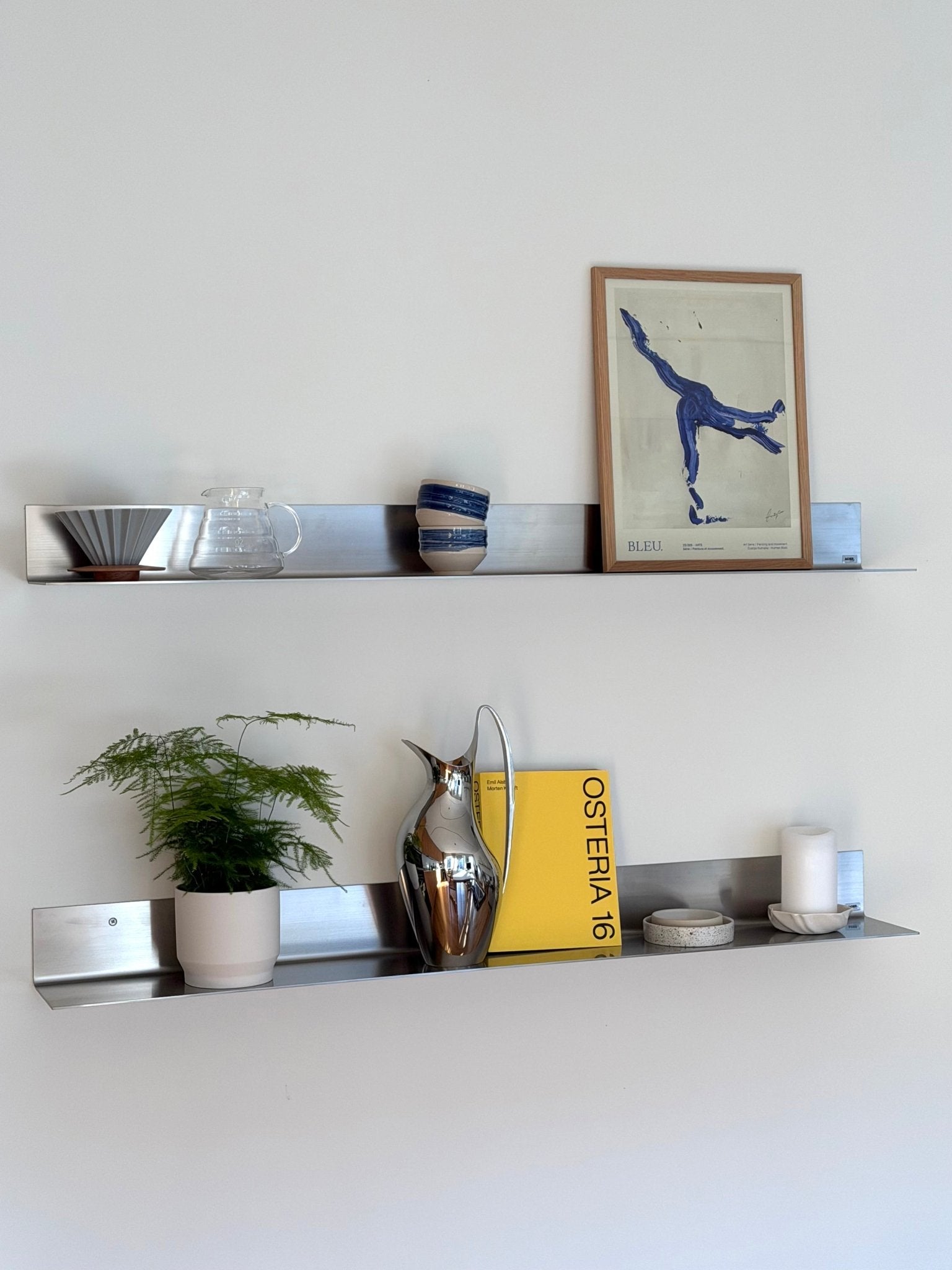
Skagen's edges are rounded enough for daily touch but maintain a precise line, allowing multiple shelves to be mounted in series without visual clutter. The hand-brushed finish has a calm, linear grain direction that is easy to maintain with spot repairs. Read more about proportions and dimensions of Skagen here: Skagen steel shelf.
Specification and Maintenance
For projects, clear specification is beneficial. Consider specifying:
- Steel type: 304 for general interiors, 316/316L for coastal areas, swimming pools, or high chloride exposure
- Surface: e.g., EN 2K/No.4 brushed, mirror polished No.8, or embossed/patterned type; define grain direction
- Thickness and span: 2.0–3.0 mm plate for 600–900 mm span; increase thickness or use folded edges for heavy loads
- Welding and finishing: TIG, visible joints planished; choose electropolishing or mechanical grain
- Mounting: wall type, brackets, center distance, and load requirements, including safety factor and hidden/exposed fastening
Maintenance should be specific. For daily use, clean the surface with mild dish soap in lukewarm water, rinse, and wipe dry with a soft microfiber cloth in the direction of the grain. Avoid abrasive cleaners, steel wool, and chlorine-based cleaning agents, as they can damage the passive film. Fingerprints are easily removed with an ammonia-free glass cleaner on mirror-polished surfaces, or a light oil/soap solution on brushed steel. For tea staining or flash rust from the surroundings, use a citric acid-based stainless steel cleaner or passivation gel, followed by thorough rinsing. The British Stainless Steel Association describes these care methods and advises against chlorine on stainless steel in interiors (BSSA — Care and Maintenance of Stainless Steel).
Wear marks can be spot repaired: on brushed surfaces, lightly work with a fine Scotch-Brite pad in the direction of the grain, always from a hidden test area. In coastal locations, regular wiping of the surface helps, especially after exposure to salt spray from open windows.
Long-Term Durability and Value
A stainless steel metal shelf carries its value in its structure. The material is dimensionally stable, easy to clean, and fully recyclable without downcycling. The level of craftsmanship in a Danish-produced shelf extends its service life, allows for surface refreshing, and makes replacement unnecessary in most interior contexts. When specification, environment, and surface are precisely chosen, a solution is achieved that patinates controllably, maintains its geometry, and provides calm in the room for many years.

