

Oslo Pedestal in Steel: Proportion, Materiality, and Interaction with the Coffee Table
Proportion and Function in the Living Space
A pedestal has two tasks in the living room: it functions as a standalone object, and it creates a vertical counterpoint to the low horizon established by a coffee table. To read clearly in the room, its height should relate to the typical coffee table height of approx. 350–460 mm; choose a pedestal that is level with or slightly higher than the table when they stand as a pair. In practice, an accompanying pedestal often measures between 400 and 700 mm. The top should provide enough surface for an object without competing with the table's use; 200–400 mm as a square or round disc is a proven range.
When a coffee table is styled according to an "anchor, vertical, organic, and air" thinking, as described by Blinde Design in their styling guide, the pedestal becomes the clear vertical marker that provides scale and rhythm alongside the anchor (the table) and an organic shape on the surface. Coordinate the finish and microtexture between the table and pedestal for overall harmony, or let a contrast in sheen highlight the different roles of the objects.
Material and Surface: Why Stainless Steel
Austenitic stainless steel combines strength, toughness, and formability with corrosion resistance, making the material suitable for precise, thin-walled furniture geometries. Grade 304 covers the vast majority of interior needs, while 316 with molybdenum provides significantly extra security against chloride and pitting corrosion in coastal environments. Outokumpu describes in their Stainless Steel Handbook how alloying and surface treatment affect resistance to stains and long-term stability (see Outokumpu Stainless Steel Handbook for a technical review).
The surface defines both appearance and maintenance requirements:
- Introduction to finish: a brushed or satin finish dampens reflections and conceals daily touches, while a mirror polish enhances light and requires careful handling of scratches.
Post-fabrication is crucial. Quality TIG welds without pores, followed by passivation of weld zones, remove free iron particles that could otherwise initiate local corrosion. For a smoother and easier-to-clean surface, electropolishing can refine the micro-topography and reduce the accumulation of deposits. This combination of steel selection, welding quality, and post-treatment is not cosmetic; it is largely what determines how a pedestal patinates and performs in everyday life.
Oslo Pedestal as a Soloist and Companion
The Oslo pedestal from Acier Studio is conceived as a serene, vertical plane in the living room. In the setup shown here, it stands to the left of the sofa, supporting a wooden object, while the Copenhagen coffee table holds a dark ceramic group. Both elements have a matte, light tonality that integrates into a warm, neutral interior without appearing cold or technical. The flat top and precise edges read as one cohesive body rather than a slab and stand, creating a unified graphic impression in the room.
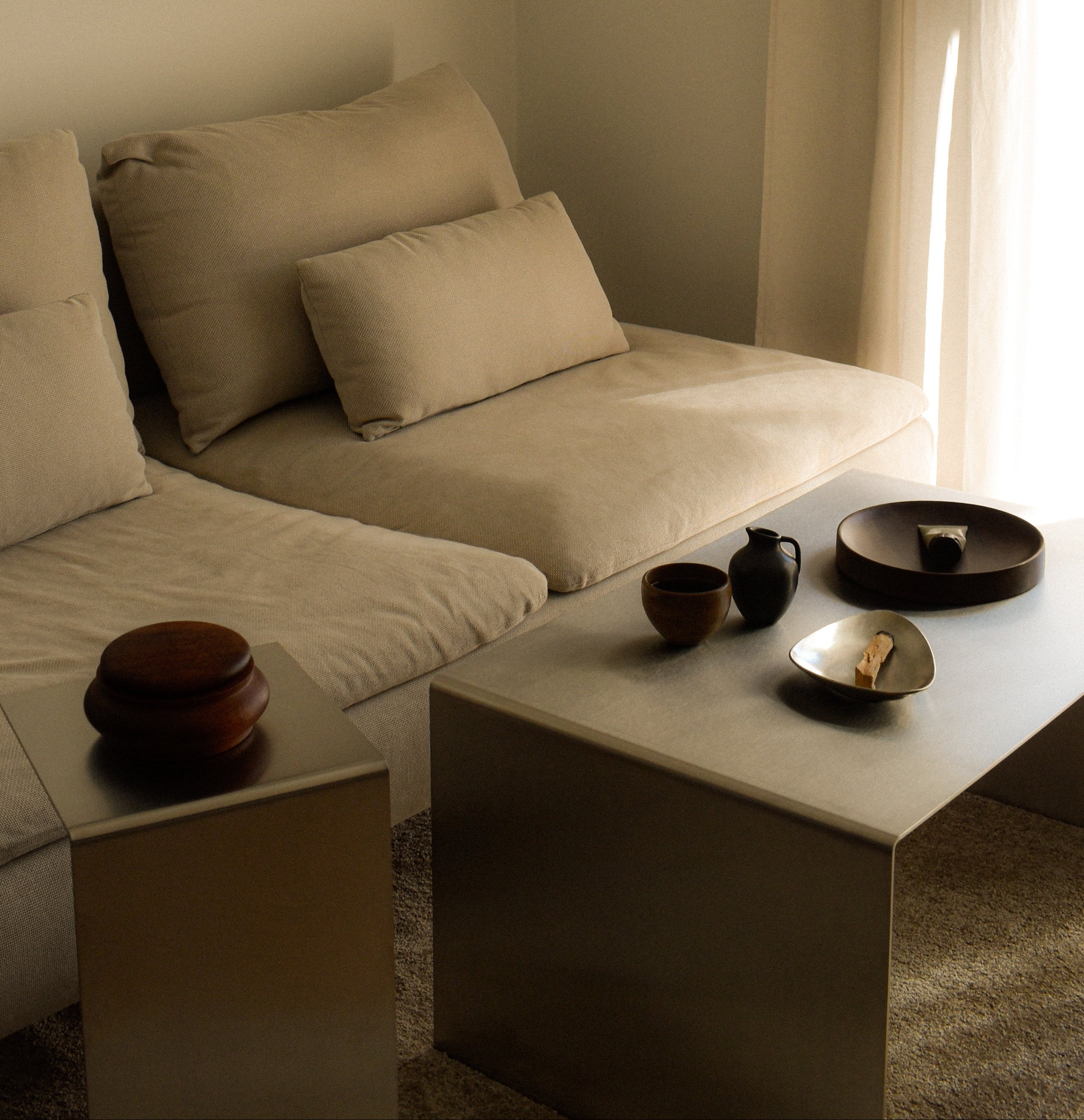
As a soloist, Oslo functions as a pedestal for a vase, a stack of books, or a smaller artwork, where the compact top creates focus. As a companion to the coffee table, it provides a convenient, secondary surface in the seating area and a clear vertical accent in the composition. The small radius of the edges is noticeable to the touch and makes the transition between surfaces smooth. The finish is a fine, matte polish that creates a uniform light distribution across sides and top, highlighting the object on the surface without glare.
Practical benchmarks for proportion and use:
- Height choice: 400–700 mm depending on whether the pedestal should align with or rise above the coffee table
- Top surface: 200–400 mm, square or round, so the object stands securely without dominating the space
- Material choice: 304 for general interiors; 316 for outdoor spaces with salt spray or coastal air
- Post-treatment: passivation of weld zones at minimum; electropolishing if mirror finish or high stain resistance is a priority
Learn more about the product on the Oslo pedestal product page.
Maintenance and Honest Use
Stainless steel is robust, but not maintenance-free. For a matte, brushed look, the method is straightforward and consistent:
- Clean with lukewarm water and a pH-neutral soap; wipe dry with a clean microfiber cloth to avoid limescale marks.
- Wipe in the direction of the grain on a brushed or satin surface. Avoid abrasive cleaners and steel wool, which can scratch and deposit foreign iron.
- Remove grease marks with isopropyl alcohol on a soft cloth, then wipe with water.
- Avoid chlorine-containing cleaning agents and bleaches, especially if the pedestal is near windows where salt and moisture can penetrate. In coastal homes, choosing 316 steel provides an extra margin.
- Use felt pads under ceramic and stone objects. Plants should stand on saucers; stagnant moisture can cause marks, even on stainless steel.
- Small scratches can be minimized with a fine sanding pad of the correct grit, used lightly and consistently in the direction of the grain. Always test on the underside first.
- If the surface is electropolished or nearly mirror-like, all abrasive agents must be avoided; use only soft cloths and mild soap.
Passivated weld zones and tight grinding lines make daily care more forgiving. It is worth inquiring about these processes because they affect how quickly watermarks and fingerprints adhere over time.
Danish Craftsmanship in Aarhus and Long-term Value
Acier Studio's production in Aarhus is small-scale and precise. Hand-selected sheets of the correct alloy, manual TIG welds with full penetration, and subsequent multi-stage grinding create sharp shadows without harsh breaks. The tolerances in joints and edge radii determine whether a pedestal reads as one body and whether the hand meets a smooth, continuous surface. This approach also means genuine reparability: a scratch can be sanded in the direction of the grain, and an edge can be fine-tuned, instead of the entire piece needing replacement.
Over the years, a steel pedestal is not just a surface for an object, but a stable reference point in the decor. The choice of correct steel, well-documented post-treatments, and craftsmanship focused on tolerances result in a piece of furniture that can be moved, rearranged, and reinterpreted without losing its geometry. When proportion, material, and workmanship work together, the form remains legible, and the surface ages gracefully. This is where long-term value arises: in a piece that can stay in the room, even as the rest changes.
References: See the Outokumpu Stainless Steel Handbook for deeper material knowledge about austenitic grades, surfaces, and post-treatment. Blinde Design's styling framework for coffee tables provides useful guidelines for balancing anchor, vertical, and air in the living room.

