

Coffee table material guide: what wood, marble, glass, powder-coated steel, and stainless steel gain and lose over time
Function first: what the material determines over the years
The choice of material determines the table's everyday behavior, how it ages, and how easy it is to maintain or repair. Five properties govern the experience over time:
- hardness and scratch resistance, porosity and stain sensitivity, heat and acid tolerance, reflection and visual calm, possibility of local repair
Organic materials: wood and marble in daily use
Wood provides warmth and tactility. Solid oak or ash develops a patina based on use, light, and choice of finish. Oil and soap-treated wood feels natural and can be refreshed, but is sensitive to liquids. Damp glasses can leave rings; in oak, iron can react with tannins and create dark marks. UV light can yellow oil, while light sanding and re-oiling often fix minor damage. Lacquer protects better against stains, but scratches in the lacquer cannot be locally toned away without re-lacquering. Wood works with humidity, so long, slender formats require proper substructure to minimize warping.
Marble provides mineral calm, but limestone and marble react chemically with acid. Lemon juice, wine, and vinegar etch polished surfaces; matte finishes hide etches better but do not change the chemistry. Natural stone is porous and should be impregnated regularly. Impregnation reduces color penetration, not etching. Over time, a use patina develops with fine matte areas, especially near coffee cups and serving. Small chips at edges are possible, especially with sharp profiles. Weight and thickness provide stability but require attention when moving.
Maintenance:
- Wood: wipe immediately if spilled, maintain with soap or oil as needed, sand in the direction of the grain for repair.
- Marble: use pH-neutral cleaners, wipe up acid spills, inspect and renew impregnation. Accept that etches will become part of the aesthetic over time.
Inert optics: glass and powder-coated steel
Tempered glass provides optical lightness and stable geometry. The material is chemically resistant to most household liquids and unaffected by UV. However, it clearly shows dust, fingerprints, and scratches, especially in direct light. Micro-scratches can occur from harder materials like ceramics. Low-iron glass reduces the greenish tint but does not change scratch sensitivity. Point loads and edges require careful consideration; tempering ensures safe breakage behavior, but repair is not possible. Maintain with glass cleaner and soft cloths.
Powder-coated steel offers color, uniformity, and good resistance to daily use. The surface film is typically 60–120 micrometers and protects against corrosion indoors. However, impacts at edges can cause chips in the lacquer; here, the steel underneath can begin to rust. Repair requires sanding, primer, and color-matched touch-up, which is rarely invisible. Fine texture in the lacquer hides minor damage better than gloss. UV can slightly fade colors over several years in sunny rooms. Clean with mild soap, avoid abrasive sponges.
Stainless steel: properties, finish, and maintenance
Stainless steel is an alloy where a thin layer of chromium oxide forms a self-repairing passive film, providing corrosion resistance. According to the British Stainless Steel Association (BSSA), high resistance is achieved with correct alloying and finish; grade 304 is suitable indoors, while 316 is recommended in coastal environments with chlorides, where pitting and tea staining can otherwise occur over time. The passive film requires oxygen to regenerate, so stagnant moisture and chloride residues should be avoided.
Surface choice controls both expression and wear patterns:
- Brushed No.4 or hairline best hides daily micro-scratches and fingerprints.
- Bead-blasted, matte surfaces provide calm reflection in bright rooms.
- Highly polished surfaces highlight precision but make small scratches and touch marks visible and require frequent polishing.
- Electropolished steel smooths micro-topography and can increase corrosion resistance and ease cleaning.
- PVD colors provide hue and improved wear and fingerprint resistance, but can locally thin on high-contact edges over many years of use.
Steel reflects light and can visually open small spaces. Choose a calmer, brushed or matte finish in sunny living rooms to avoid glare; combine with textured textiles and warm woods for balanced contrast.
Maintenance:
- Wipe daily with microfiber and mild dish soap, rinse and dry to avoid limescale stains.
- Use isopropyl alcohol for grease or tape residues.
- Polish and "repair" minor scratches on brushed surfaces with a fine abrasive sponge in the direction of the grain. Avoid chlorine-containing agents and steel wool, which can leave particles and promote tea staining.
Product insight: Copenhagen coffee table in the home
The Copenhagen coffee table from Acier Studio is developed with a focus on proportion, hand-finished transitions, and grain continuity in the brushing, so surfaces and edges read as one unified volume. In the picture, the table is shown in a matte, light-toned finish, which dampens reflection and integrates into a warm, neutral interior. The visual calm of the surface allows dark ceramic objects and a tray to stand out clearly without creating visual clutter. Next to it, the Oslo pedestal is seen as a sculptural counterweight, demonstrating how two steel elements can be incorporated into a soft, textile-rich environment with a linen sofa and earthy tones.
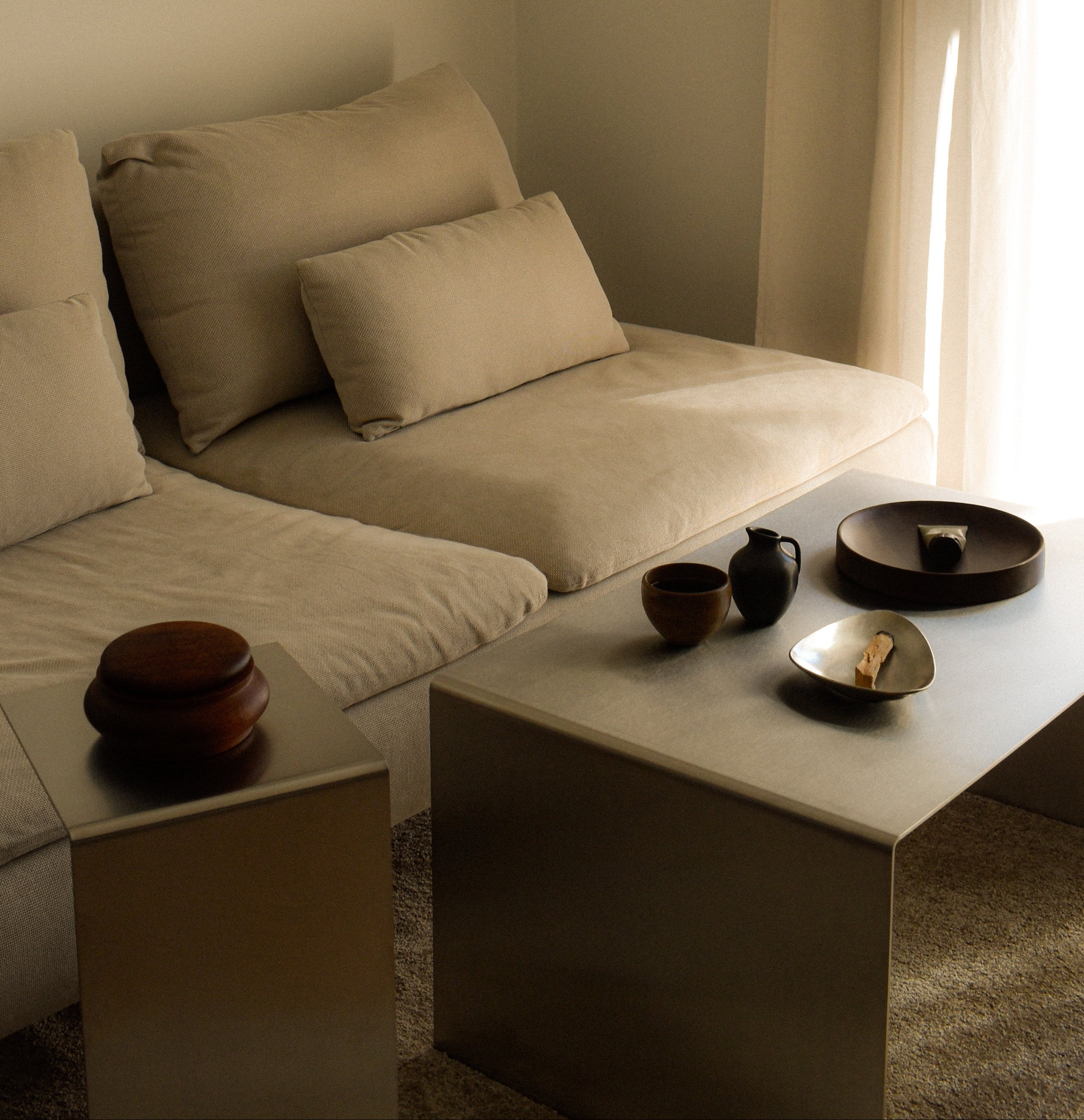
The Copenhagen coffee table is made of solid stainless steel with precise joints and a hand-sanded finish that can be maintained locally with directional polishing. This ensures predictable aging and the possibility of resetting wear marks, unlike painted or lacquered surfaces. See the product here: Copenhagen coffee table
Danish manufacturing and long-lasting value
The craftsmanship behind Danish-produced steel furniture prioritizes fit, weld finish, and the possibility of future disassembly and repair. Continuity in brushed grain, precise radii, and consistent material choices create a calmer patina because wear distributes evenly and can be worked on locally without changing components. This approach reflects a tradition of human scale and proportion, as well as a often discreet but consistent material logic. Read more about processes and materials here: Production and materials
Over a decade, materials change differently. Wood gains character and can be renovated but requires rhythmic care. Marble patinas beautifully for those who accept etching and rewards diligence. Glass remains visually light but shows everyday traces. Powder-coated steel maintains color and form, though with vulnerable edges and limited invisible repair. Stainless steel combines structural stability with a repairable surface; it changes the least but develops small signs of use that can be managed through finish and maintenance.
Long-lasting value is achieved when the material's chemistry, its surface treatment, and the production behind it are in balance with the space where the table will live. A coffee table that can withstand everyday life and also be serviced with a cloth, a fine abrasive sponge, and calm routines, retains not only its function but its integrity. Within this framework, stainless steel provides a particularly robust durability that makes the investment predictable over time.

