

Steel Desk for the Home Office: Durable, Ergonomic, and a Design-Strong Alternative to Wood and MDF
A stainless steel desk offers functional advantages that are difficult to achieve with wood and MDF. The material withstands high point loads without yielding, maintains dimensional stability through decades of use, tolerates professional cleaning agents, and enables sleek profiles that free up legroom and support equipment such as monitor arms and cable trays. In a home office, this means fewer compromises between ergonomics, maintenance, and a calm, contemporary aesthetic.
Material properties that make a difference
Stainless steel (typically AISI/EN 304 or 316 for furniture) combines high tensile strength and a Young's modulus of around 190–200 GPa with a density of approximately 8 g/cm³. This combination results in rigid, low-vibration constructions with relatively thin material thicknesses compared to wood-based panels. The self-healing chromium oxide film provides corrosion resistance in indoor environments and allows for surfaces that can withstand moisture, hot objects, and mild chemicals from daily cleaning. ScienceDirect describes how these properties differentiate 304 and 316, and why 316 performs better in chloride-rich environments near coasts (sciencedirect.com/topics/materials-science/stainless-steel).
In practice, the benefits of a steel desk are experienced as:
- high rigidity in slender sections, stability for monitor arms, and easy adjustments without visible deflection
- smooth, long-lasting surface with the possibility of re-finishing for scratches
- resistance to heat, moisture, and most cleaning agents
- full recyclability at the end of its life cycle
The choice between 304 and 316 depends on placement. For general indoor spaces, 304 is usually sufficient. In salty or pool-side environments, 316 reduces the risk of tea-staining from chlorides. Surfaces also affect the experience: a brushed satin finish hides small scratches and reduces glare; a mirror-polished surface reflects more light but shows fingerprints more clearly.
Ergonomics and interior design in the home office
Steel reads visually light and precise. It provides space around the body but requires careful consideration of finish and acoustics. A brushed or matte electropolished surface reduces glare from screens, and a slightly rounded edge profile at the wrist zone provides comfort during long writing sessions. A rigid steel frame handles the weight of height-adjustable mechanisms and monitor arms without resonance; choose a tabletop design where cable trays and pass-throughs are integrated so that wires don't hang at knee height.
Material-wise, you can combine a steel frame with a separate wooden top for tactile warmth if the room has many hard surfaces. In small rooms, a light, slightly reflective steel frame can visually expand the space, while felt pads, cable channels, and acoustic textiles under the table dampen vibrations from the keyboard and equipment. In the overall room, steel works well with oak, leather, and wool; the warm tones balance the material's cool sobriety without disrupting its clear geometry.
Danish craftsmanship in Aarhus: small series, high tolerances
Handmade metal furniture production in Denmark is based on small series, material control, and close dialogue between designer and smith. In Acier Studio's workshop in Aarhus, mill-certified plates and profiles are selected, seams are fully welded and blended flush, and brushing is continuously applied across joints so that surfaces read as whole. This results in tighter tolerances, precise joints, and soft edge profiles that are felt in daily use at a desk.
This approach goes beyond finish. When dimensions are adjusted, the frame sections can be scaled without losing rigidity, and fittings can be designed to be repaired or replaced. The Danish Design Center precisely describes how material knowledge and small-scale production extend the lifespan of furniture through repairability and finish control. Our process and material selection are described in detail in Production and materials at acier.dk/en-us/blogs/news/production-material.
Product insight from the workshop
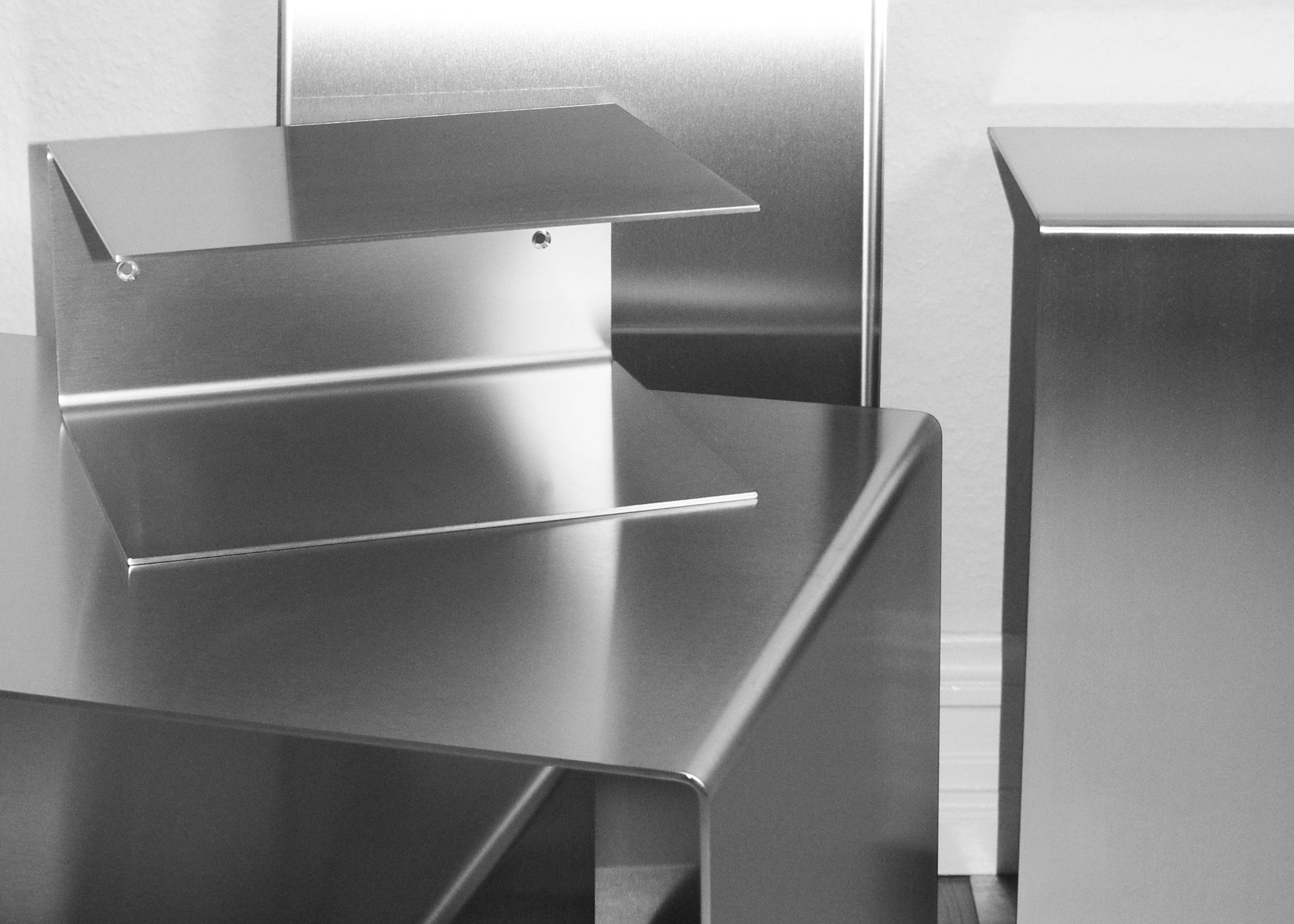
The studio shot features a Lund bedside table, a Skagen shelf, a coffee table from the Copenhagen/Uppsala line, and the Oslo pedestal. The close-up reveals craftsmanship techniques that are central to a good steel desk: folded bodies with sharp, straight edges; fully welded corners that are subsequently planed flush and brushed in a consistent grain direction; and proportions that allow the material's rigidity to work in thin sections. The same principles applied to a desk mean that a frame can remain visually light, even when supporting heavy IT setups, and that the tabletop can have a small, consistent radius at the back of the hand without visible joints in the usage zone.
The flat, brushed surfaces of the Skagen shelf show how grain direction controls light and reduces glare. The precise geometry of the Oslo pedestal illustrates folding techniques that provide strength without unnecessary mass. And in the coffee tables, the uniform brushing is read across large surfaces, a discipline also crucial for a desk's work zone, where lamps and screens can quickly reveal imperfections.
Maintenance, surfaces, and honest patina
Stainless steel requires little, but correct, care. Euro Inox recommends mild, pH-neutral detergent in warm water for daily wiping, always in the direction of the brushing; wipe dry with a soft microfiber to avoid limescale streaks (euro-inox.org). Fingerprints can be removed with isopropyl alcohol or a dedicated chloride-free steel cleaner. Avoid chlorine bleaches and steel wool, which can leave particles and cause rust film.
Small scratches in a brushed satin finish can be toned down with a fine, non-woven abrasive sponge in the direction of the grain. Always test on an inconspicuous area first. Mirror-polished steel does not hide marks to the same extent and requires more frequent, gentle polishing. In the home office, felt pads under the desk's feet help with both acoustics and protecting the floor surface. If the table is near an open window in coastal areas, 316 execution and regular wiping reduce the risk of superficial discoloration from salts. If the steel top often meets hard objects, protect the work zone with a desk pad of leather or wool felt; this dampens sound and reduces point pressure, without hiding the material's expression.
To maintain the precision of height adjustment and fittings, screws and adjustments should be checked annually. If an edge is damaged, a hand brushing and local re-finish in the workshop can restore the surface; this is one of the advantages of solid material versus foiled panels.
Perspective on long-term value
A steel desk is not just a surface to work on. It is a constructive solution that retains its geometry, tolerates repair, and can be fully recycled at the end of its life. The rigid frame supports ergonomic upgrades without the need for the desk to be replaced, and the surface can be re-imagined with new brushing or other finishes if the room changes. When the material's strengths are combined with Danish small-scale production, precise edges, and controlled surfaces, a workstation emerges that can keep up over time, through moves and changed work habits—with a calm, technical aesthetic that does not become outdated by fashion.

