

Steel wall-mounted bedside table: why it beats freestanding solutions
A wall-mounted bedside table frees up floor space, simplifies cleaning, and eliminates tip-over hazards. With the tabletop floating above the skirting board, vacuum cleaners, mops, and robots can pass freely without obstruction from legs or plinths. Visually, it lightens the room; in small bedrooms, the effect is noticeable because the floor reads as one continuous surface. At the same time, firm anchoring in the wall makes the furniture immovable during use; no wobbly legs, no swaying, and no conflict with the lines of the headboard.
Stability and safety begin in the wall
The strength of a wall-mounted solution depends on two factors: correct load distribution and correct fastening to the specific wall type. A well-designed construction uses a hidden steel backplate with a generous contact surface, so forces are distributed evenly into the wall. Keyhole slots or slotted, countersunk holes allow for fine-tuning to ensure it's level and make servicing easy, as the unit can be lifted off if needed.
Mounting should be adapted to the wall:
- Brick and aerated concrete: quality plugs or sleeve anchors in the correct drill hole
- Concrete: expansion anchors or screw plugs with high pull-out resistance
- Drywall: look for studs where possible; otherwise use metal toggles or hollow-wall anchors dimensioned for both weight and torque
Position the bedside table slightly above the skirting board for a clean finish. Choose a consistent height relative to the mattress height; the top edge close to the top of the mattress provides the best ergonomics, so lamps, books, and glasses stand securely.
Material logic: stainless steel, surfaces, and maintenance
Stainless steel owes its corrosion resistance to a self-healing passive film of chromium oxide. Grade selection and surface finish determine actual use environment and stain resistance; as Outokumpu documents, austenitic grades like 304 provide good indoor durability, while 316/316L increases resistance to chloride-containing environments near the coast or in bathrooms (see Outokumpu’s review of corrosion resistance: https://www.outokumpu.com/expertise/stainless-basics/corrosion-resistance?utm_source=openai).
The surface affects both appearance and ease of cleaning:
- No.4 brushed: distinct grain direction, tactile, and robust everyday surface where scratches read as patina
- 2B (mill): matte, even technical finish with low gloss, discreet and calm
- No.8/mirror or electropolished: very smooth, high reflection, and minimal micro-roughness, which reduces dirt adhesion
True utility lies in the details: uniform grain direction across all surfaces, sharp tolerance controls in bends and joints, and clean inner surfaces where pages and glasses won't scratch.
Maintenance should be honest and simple. Wipe daily with microfiber. Use mild, pH-neutral dish soap in lukewarm water for grease and fingerprints; wipe in the direction of the grain. Avoid chlorine-based cleaners, bleach, and steel wool. A sparse film of mineral oil or dedicated stainless steel cleaner can reduce fingerprints on brushed surfaces. Check fastenings after the first 3–6 months, especially on drywall; repeat annually in homes with large humidity fluctuations.
Lund from Acier Studio: wall-mounted stainless steel bedside table
Lund is our wall-mounted stainless steel bedside table, handcrafted in Aarhus with proportions that accommodate both a lamp and a reading book without dominating the room. The top surface is flat and rigid, while a low, integrated shelf underneath holds magazines with full depth, so their spines don't catch on the wall. The grain direction is uniform on all visible sides for a calm interplay with light, and edges are subtly rounded, making touch feel controlled rather than sharp.
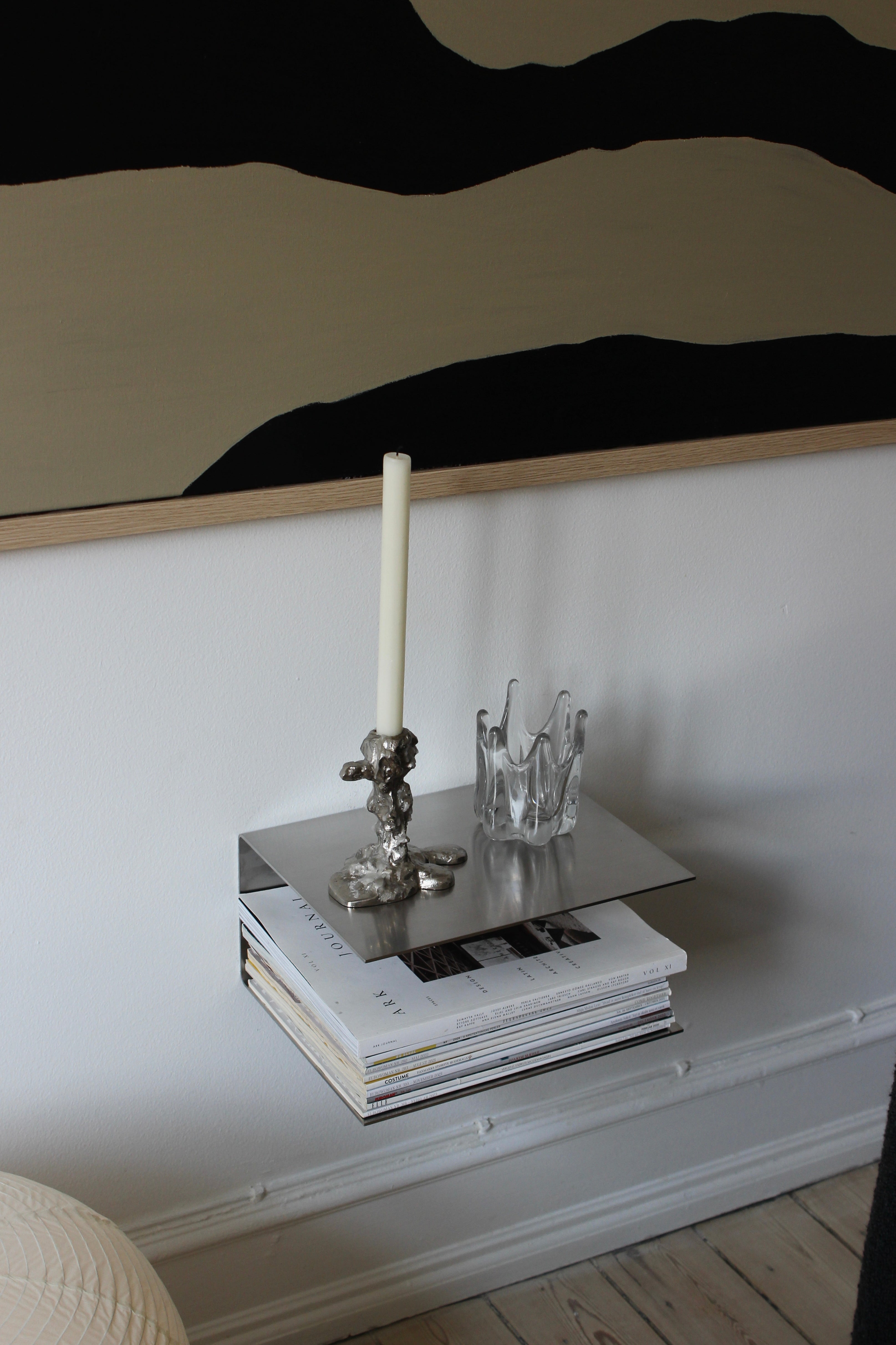
The mounting is intentionally discreet. A hidden steel backplate distributes the load, and keyhole brackets ensure that Lund can be hung after the wall anchors are set. Slotted holes allow for level adjustment; after tightening, all screws disappear behind the body, so the wall and table read as one unit. The system can be cleanly mounted on all common wall types, provided correct fastenings, and the back edge is dimensioned to meet the wall above a standard skirting board without visible gaps. See more specifications on Lund's product page: https://acier.dk/products/lund-staal-natbord
In use, the difference is experienced daily: the floor is free for cleaning, the bedside lamp's cord can be routed behind the edge and down to the outlet without hanging, and it doesn't tip over when reaching out in the dark. The lower shelf can hold a solid stack of magazines without bending, because the bend radius and material thickness are aligned with the beam's span.
Danish workshop production in Aarhus: precision over volume
Acier Studio operates small-scale production with tight tolerances. Pieces are cut and laser-cut, bend lines are fixtured in jigs for repeatable angles, and corners are TIG-welded, after which seams are ground flush and regrained so the grain continues unbroken around the piece. Inner surfaces are chamfered and deburred to prevent tearing paper; visible surfaces are inspected under glancing light for uniform strokes. Details like hidden backplates, rows of keyholes, and tight tolerances between wall and body are choices that require time at the bench. Read more about our method under Production and Materials: https://acier.dk/en-us/blogs/news/production-material
This approach is an extension of the Danish furniture tradition, where prototypes, refinement, and material understanding are prioritized over sheer volume. The result is furniture that ages slowly, because construction, surface, and assembly are conceived as a whole.
Interaction in interior design
Steel works best as a controlled contrast. A wall-mounted bedside table in brushed stainless steel doesn't clutter visually; it connects to the wall and allows textiles and wood to provide warmth. Combine with oak, leather, and stone for a Scandinavian material language where cold and warm elements balance. In smaller bedrooms, the free floor space provides depth and air, while a consistent height on both sides of the bed creates calm symmetry.
Long-term perspective
A wall-mounted steel unit offers three long-term benefits: it doesn't occupy floor space, it maintains its geometry without maintenance of legs or fittings, and the steel retains its integrity in changing indoor climates. With correct wall anchoring and simple cleaning, the lifespan is long; the surface will patina with use, but function and precision remain. In a home that needs to evolve over time, it is precisely this combination of spatial discipline, strength, and material-honest simplicity that provides lasting value.

