

Bergen Steel Shelf
A shelf that needs to both display and support requires stable depth, precise geometry, and a material that does not yield under stress. The Bergen steel shelf is designed for precisely that; its 15 cm deep profile provides real support for everyday items and objects without visually dominating the space.
Function, Profile, and the Difference to Skagen
Bergen is developed as a combined display and storage shelf in 3 mm brushed stainless steel. The profile is stated as 10 x 15 cm (H x D), which provides a taller, calm backplate and a projection that accommodates bowls, glasses, small stacks of paperbacks, and curated objects. In practice, the extra centimeters of depth mean that items stand stably and can be arranged in layers without protruding too far into the room. The manufacturer's own recommendation for practical load is around 30 kg with correct mounting in a solid wall or studs, making the shelf equally suitable for daily use and pure display.
Compared to Skagen, Bergen reads more as a standalone object with a clear presence. Skagen, in the same series, prioritizes composite wall arrangements where multiple widths are combined for rhythm and flexibility. Both models share material thickness, brushing direction, and depth, but Bergen emphasizes the calm, deeper profile and the visual serenity of functioning solo or in short, measured groupings. See specifications for dimensions and finish on the product page for Bergen steel shelf at Acier Studio:
- Kitchen and dining room for glasses, cups, and bowls, where the depth provides a safe distance from the front edge
- Living room and hallway for smaller books, keys, bowls, and glazed items
- Office and studio for reference materials, prototypes, and tools, where the surface tolerates frequent wiping
- Gallery and project environments, where the backplate creates a clean line behind objects
- Bathroom, provided correct installation and suitable cleaning agents without chlorides
Pair Bergen with warm wood types, stone, or textiles for tactile contrast; the depth allows for layering, while the steel's brushing direction maintains overall calm in the light.
Material and Construction: Stainless Steel in Practice
Bergen is made of austenitic stainless steel with a directional brushing (no. 4). The chromium-rich passive oxide film on the steel's surface provides robust corrosion resistance indoors; austenitic 304 is standard for general environments, while 316 is used where there is chloride exposure or coastal air. Outokumpu describes how this passive film rebuilds itself if damaged, which is one reason for the material's long lifespan in interiors: Outokumpu knowledge about stainless steel
The steel's high yield and tensile strength make it possible to work with slender, folded profiles that bear weight without flexing. The folded geometry of Bergen provides a rigid shelf surface and a backplate that distributes the load back to the wall. The brushed finish in no. 4 direction masks daily fingerprints better than mirror-polished surfaces and is easy to refresh by wiping in the brushing direction.
First Impressions from the Workshop in Aarhus
Small Danish workshops like Acier Studio in Aarhus follow a detailed craftsmanship process that is difficult to replicate in mass production. Bends are hand-finished so that radii and edges are uniform. Welded ends, where relevant, are ground flush and completed so that the surface appears continuous. Items are cleaned of particle contamination and passivated, after which each shelf is individually quality-controlled for optical flatness and stability. Euro Inox's guidelines emphasize that weld finish, contamination control, and a clear surface specification are crucial for service life; in low volume, these steps can be carried out thoroughly and consistently.
This approach is seen on Bergen in its sharp, precise lines, even brush pattern, and calmly reflective plane, undisturbed by weld marks. The tolerances in the folding mean that the shelf is mounted level, so both light glasses and heavier objects stand stably along the entire width.
Bodø in Use: Three Scenarios
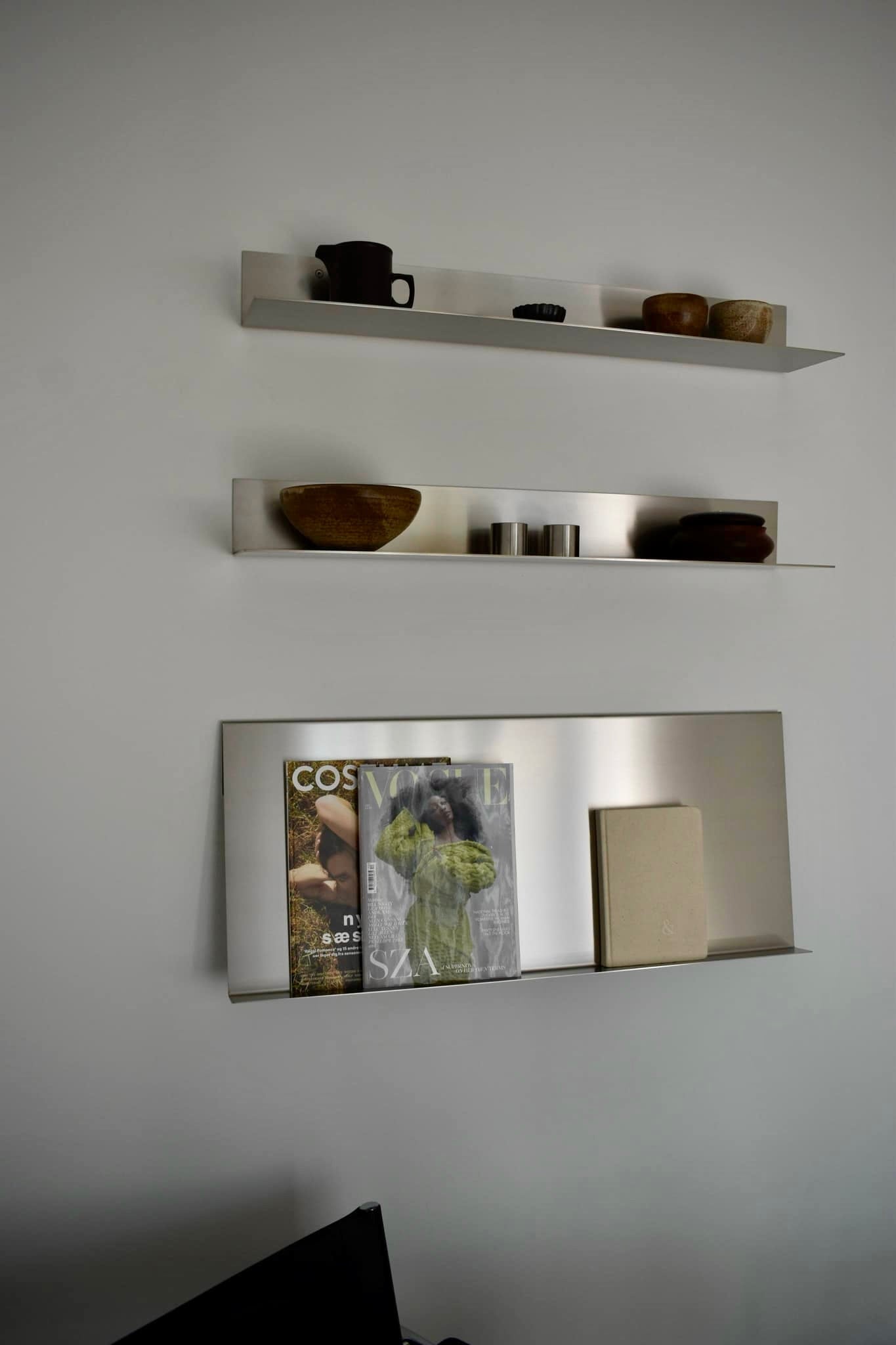
The image series above shows Bodø, a related wall-mounted stainless steel shelf, set in three distinct use scenarios: at the top, ceramics and wooden objects; in the middle, bowls and containers with the slightly reflective interior surface in play; at the bottom, magazines and a hardcover title standing upright against the backplate. The examples illustrate the practical advantage of a deeper profile with a distinct backplate: objects stand securely, layering is possible, and the shelf creates a precise shelf edge in the room. The same principles apply to Bergen, which is dimensioned for daily use and display on a wall.
Maintenance and Long-Term Value
- Wipe in the brushing direction with a slightly damp microfiber cloth and a pH-neutral cleaner. Rinse with clean water and dry thoroughly to avoid limescale streaks.
- Avoid chloride-containing agents, chlorine, and abrasive scouring creams. Never use steel wool, which can leave particles and cause "tea stains".
- Fingerprints and grease are effectively removed with isopropyl alcohol on a soft cloth, again in the brushing direction.
- Small tea stains from contamination can be removed with a fine, non-woven abrasive pad, moved in the same direction as the brushing. Finish by wiping and drying.
- In bathrooms or coastal homes, cleaning should be more frequent; for particularly aggressive environments, a 316 version can be discussed with the workshop.
Stainless steel changes minimally over time and can be refreshed without losing the material's character. When a shelf is correctly folded, passivated, and quality-controlled, it performs its function for decades with maintainable care. Bergen thus represents a long-lasting solution: it is a piece of precision-manufactured interior that remains dimensionally stable, retains its surface, and can be integrated into various rooms over many years, without compromising its daily utility.

