

Stainless Steel Coffee Table: Finish Types That Control Light, Use, and Lifespan
On a stainless steel coffee table, the surface finish dictates as much as the form what you see in the room today and how the furniture ages tomorrow. Three factors are crucial: the steel's corrosion resistance, the surface roughness (Ra), and hardness. A rougher surface scatters light and conceals fingerprints and fine scratches; an ultra-fine, mirror-polished surface reflects sharply but reveals everything. The choice between brushed, satin, and mirror-polished is therefore not just aesthetic; it is a choice of light behavior, maintenance level, and long-term durability.
What the finish does to the light, and what it shows or hides
Furniture finishes on stainless steel are mechanical treatments that result in varying degrees of roughness and reflection. According to Euro Inox – Guide to Stainless Steel Finishes (No.4, No.6, No.8), roughness, often indicated as Ra, describes how much light is scattered, and thus how visible small marks become. No.4 brushing typically ranges around Ra 0.4–0.8 µm; a fine satin finish is lower; a No.8 mirror polish approaches Ra < 0.1 µm. Simultaneously, steel quality plays a role: 304 is sufficient in dry, indoor environments, while 316 with higher molybdenum content better resists stains in humid or coastal interiors. Chemical passivation of the finished surface stabilizes the protective film and reduces the risk of tea stains over time.
- Brushed (No.4): Distinctive, directional grain, evident tactility, and even, matte sheen. Light is effectively diffused; fingerprints and fine scratches are camouflaged. Naturally complements matte textiles, wool, and concrete. In the living room, it withstands daily use, even with children or guests, because marks can be blended along the grain direction. Typical Ra 0.4–0.8 µm.
- Satin (fine brushed/No.6-like): Softer, more cohesive grain pattern with a weaker directional sense and a subtle, silky matte reflection. Balances warm woods and stone; acts as a neutral bridge between natural materials and modern surfaces. Hides light smudges, but is more light-active than coarse brushing. A good solution for living rooms and hospitality settings where calm and robustness are desired.
- Mirror-polished (No.8): Almost completely reflective, high specular reflection, and very low roughness. Enlarges and brightens tight spaces, especially when the table is placed opposite a window or artwork. Clearly shows greasy fingerprints, dust, and micro-scratches; requires continuous wiping and occasional fine polishing. Suitable for minimalist, high-gloss environments where discipline in use and care is in place.
Outokumpu’s surface brochures describe the relationship between Ra, diffuse versus specular reflection, and visibility of wear marks; this confirms the above rules of thumb for furniture use in homes and businesses.
Uppsala: a double-level coffee table in stainless steel
Uppsala is a low, substantial coffee table with an integrated lower shelf, handcrafted in Aarhus. The top features a combination of brushed and lightly polished steel, which provides a controlled fall of light on the surface, while the lower shelf works darker in the room, creating depth. The directional grinding continues cleanly over edges and joints; this provides a calm reading without breaks in the grain, even where legs meet the plate.
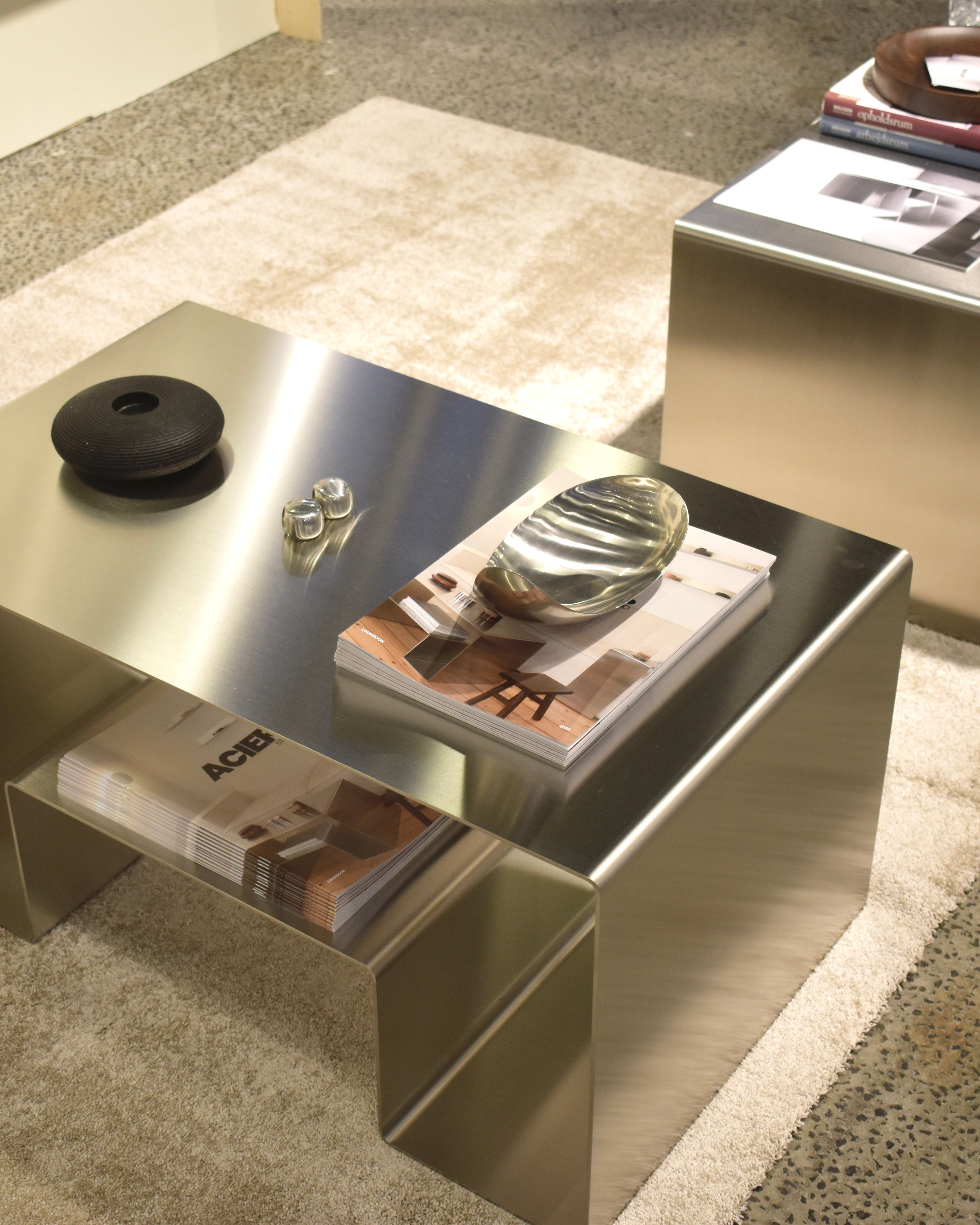
In the room, the upper surface reads as a calm field that collects objects and books without harshly reflecting them. The lower shelf holds magazines and remote controls, allowing the top to remain open. Placed perpendicular to a window, the table casts a soft sweep of light into the seating area; flanked by wool and linen, it provides a balanced contrast between metal and textile. See more specifications at Uppsala coffee table.
Maintenance: what works and what to avoid
Stainless steel is durable but not maintenance-free. Frequency and method depend on the finish.
Brushed and satin:
- Daily: Wipe with microfiber and lukewarm water with a drop of pH-neutral dish soap; dry along the grain direction.
- Fingerprints: Isopropyl alcohol on a soft cloth removes grease without affecting the sheen.
- Minor scratch repair: Use a fine abrasive sponge/Scotch-Brite with appropriate grit (typically "ultra fine") and work in long, straight strokes along the grain direction. Finish with a satin/brushing paste if desired. On satin surfaces, movements should be light and even to avoid "drawing" too distinct a grain.
- Avoid: Chlorine-based cleaners, steel wool, and circular motions that disrupt the grain.
Mirror-polished:
- Daily: Dust with a dry microfiber; remove fingerprints with ammonia-free glass cleaner or diluted isopropyl alcohol. Use a clean, soft cloth; apply light pressure.
- Periodically: Fine polishing paste designed for stainless steel on a foam applicator; work linearly and minimally. Always test on an inconspicuous area.
- Avoid: Abrasives, scouring pads, and harsh towels. Any dulling will be visible.
Environment and steel quality:
- In coastal or humid interiors, tea stains are minimized by choosing 316 steel and ensuring surfaces are passivated after grinding and welding. A citric or lemon acid-based passivation gel can be applied by a professional if a repair has broken the passive film.
- Wipe away condensation or spills quickly; do not let salty or chlorinated water dry on the surface.
Euro Inox describes how correct finishing and passivation around joints and welds significantly reduce the risk of localized corrosion, especially where hands frequently touch the edge.
Danish craftsmanship in Aarhus: why it lasts
The handcrafting in Aarhus relies on TIG welding with tight tolerances and hand-blended grinding over weld seams, ensuring the grain runs uninterrupted. Edge radii are specified according to the furniture's proportions; sharp enough to look precise, but gentle on textiles. This consistency in finish across surfaces and joints does two things over time: Firstly, the table ages evenly because light is refracted uniformly regardless of angle; secondly, minor repairs can be performed in situ without leaving "islands" of deviant grain. This is difficult to achieve in machine-produced series, where batch differences in grain and pressure quickly become visible in a living space.
Outokumpu's technical materials emphasize that a uniform mechanical finish and controlled grain direction reduce the appearance of operational marks in user environments; precisely what the craftsmanship seeks to ensure in a piece of furniture that lives in everyday life.
Long-term value
The choice between brushed, satin, and mirror-polished is about matching the room, light, and usage habits. Brushed thrives in family rooms with tactile calm and simple care; satin bridges materials and maintains its expression with normal use; mirror-polished magnifies formal spaces when continuous care is accepted. With correct steel quality, thorough hand-grinding, and honest maintenance, a stainless steel coffee table will develop a discreet, uniform patina rather than wear. This is where the true value lies: in a piece of furniture where the finish is carefully chosen, reacts predictably to everyday life, and can be maintained for decades without losing its integrity.

